In the following figure is AC || QR, then Y = ?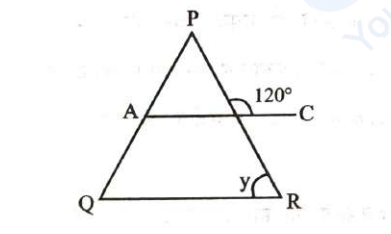
120°
In triangle PQR, point A lies on PQ and point C lies on PR, with AC drawn parallel to QR, so PR acts as a transversal cutting the two parallel lines AC and QR.
The angle marked 120° at C is the angle PCA, formed between CA and CP, on the side of the transversal facing P.
Since AC || QR, triangle PAC is similar to triangle PQR, and angle PCA corresponds to angle PRQ, so these corresponding angles are equal.
Angle y is the angle QRC, which is the same as angle PRQ since C lies on segment PR. Therefore y = angle PCA = 120°.
Similar Questions
The angles of a triangle are 2x°, (3x−8)° and (5x−12)°. The greatest angle of the triangle is:
Important Questions from Triangles
Among the following options, which are NOT sides of a triangle?
In a Δ ABC, if ∠A = 120° and AB = AC, then the values of ∠B and ∠C are respectively:
In the equilateral Δ ABC, the base BC is trisected at D and E. The line through D, Parallel to AB, meets AC at F and the line through E parallel to AC meets AB at G. If EG and DF intersect at H, then what is the ratio of the sum of the area of parallelogram AGHF and the area of the Δ DHE to the area of the Δ ABC?
The product of the perimeter of a triangle, the radius of its in‐circle, and a number gives the area of the triangle. The number is
A man goes 24 m towards east and then 10 m towards north. How far is he away from his initial position?