
Suppose that the register A and register K have the bit configuration. Only the three leftmost bits of A are compared with memory words because K has 1's in these positions. Because of its organization, this type of memory is uniquely suited to parallel searches by data association. This type of memory is known as
Content addressable memory
Understanding Content Addressable Memory (CAM)
The question describes a specific type of memory organization characterized by several key features:
- It uses registers, specifically A and K, for comparison operations.
- It allows for selective comparison of bits within memory words against the content of a register (register A). The mask register (register K) determines which bits are relevant for the comparison (where K has 1s).
- It is uniquely suited to parallel searches.
- The searching is done by data association, meaning you search for the content itself rather than an address.
Let's analyze how these features relate to different types of memory.
Analysis of Memory Types
RAM (Random Access Memory)
RAM is a type of volatile memory where data can be read from or written to any memory location directly, provided its address. Searching in typical RAM is done sequentially or through indexing after knowing the address. It does not inherently support parallel search based on data content across all locations simultaneously. The description's emphasis on parallel search by data association doesn't align well with the primary function of standard RAM.
ROM (Read-Only Memory)
ROM is a type of non-volatile memory where data is typically written once (or a limited number of times) and read many times. Like RAM, accessing data in ROM is usually address-based. It is used to store firmware or boot instructions. It does not possess the characteristics of parallel searching by data association described in the question.
Secondary Memory
Secondary memory, such as hard drives, SSDs, or optical drives, provides non-volatile storage for large amounts of data. Access to secondary memory is significantly slower than primary memory (RAM). While searches are performed on secondary storage, the mechanism described involving parallel comparison of specific bits using mask and data registers against memory words is not characteristic of typical secondary storage systems.
Content Addressable Memory (CAM)
Content Addressable Memory (CAM), also known as associative memory, is a special type of computer memory used in certain high-speed searching applications. Its key features include:
- Content-based search: Instead of providing a memory address, you provide the data you are looking for.
- Parallel search: All memory locations are searched simultaneously for the matching data.
- Mask register: A mask register is often used to specify which bits of the search data are significant for the comparison. Bits corresponding to 0s in the mask register are ignored during the comparison. This matches the description where register K acts as a mask.
- Data register: The data to be searched is typically held in a data register (like register A in the question).
The description provided in the question perfectly matches the operational principles of Content Addressable Memory (CAM). The use of register A for search data, register K for masking which bits are compared, and the emphasis on parallel searches by data association are all defining features of CAM.
Conclusion
Based on the detailed characteristics provided - parallel search, comparison of specific bits using masking (register K) and search data (register A), and data association - the type of memory uniquely suited to these operations is Content Addressable Memory.
| Feature | RAM | ROM | Secondary Memory | Content Addressable Memory (CAM) |
|---|---|---|---|---|
| Access Method | Address-based | Address-based | Block/Address-based (Slower) | Content-based |
| Search Method | Sequential/Indexed (address needed) | Sequential/Indexed (address needed) | File system search (software) | Parallel comparison of content |
| Mask Register Support | No inherent support | No inherent support | No inherent support | Yes (defines significant bits) |
| Parallel Search by Data Association | No (primarily address-based) | No (primarily address-based) | No (software-based search) | Yes (core function) |
Revision Table: Memory Types and Features
This table summarizes the key differences related to the question's context.
| Memory Type | Search Mechanism Highlighted | Mask Register Usage | Parallel Search Capability |
|---|---|---|---|
| RAM | Address-based access | Not applicable | No (for content search) |
| ROM | Address-based access | Not applicable | No (for content search) |
| Secondary Memory | File/Block access (software search) | Not applicable | No (for high-speed hardware search) |
| Content Addressable Memory (CAM) | Content-based search | Used for bit masking (e.g., Register K) | Yes (searches all locations simultaneously) |
Additional Information: Content Addressable Memory (CAM) Applications
Content Addressable Memory is used in applications where high-speed searching is critical. Some examples include:
- Network routers and switches for forwarding lookups (matching destination IP addresses to next hops).
- Cache controllers for tag matching.
- Database acceleration.
- Data compression hardware.
The parallel search capability allows CAM to perform lookups much faster than traditional RAM-based systems that might require iterating through entries or using complex tree structures for searching.
The size of CAM is typically much smaller than RAM due to its complex internal structure (each cell needs comparison logic), making it more expensive per bit.
Important Questions from Memory Hierarchy
Consider a system with 2 level cache. Access times of Level 1, Level 2 cache and main memory are 0.5 ns, 5 ns and 100 ns respectively. The hit rates of Level 1 and Level 2 caches are 0.7 and 0.8 respectively. What is the average access time of the system ignoring the search time within cache?
Related to computers, what is 'Wetware'?
____ number of lines are required to select __________ memory locations.
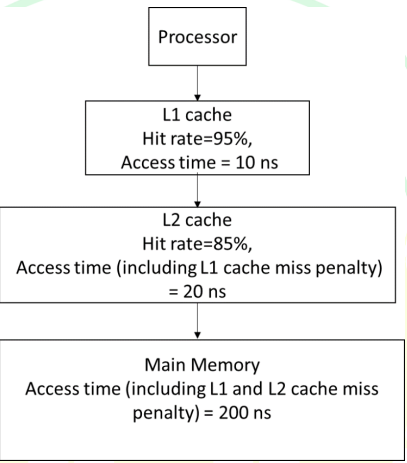
A computer has a memory hierarchy consisting of two-level cache (L1 and L2) and a main memory. If the processor needs to access data from memory, it first looks into L1 cache. If the data is not found in L1 cache, it goes to L2 cache. If it fails to get the data from L2 cache, it goes to main memory, where the data is definitely available. Hit rates and access times of various memory units are shown in the figure. The average memory access time in nanoseconds (ns) is ________. (rounded off to two decimal places)
- Given a computing system with two levels of cache (L1 and L2) and a main memory. The first level (L1) cache access time is 1 nanosecond (ns) and the “hit rate" for L1 cache is 90% while the processor is accessing the data from L1 cache. Whereas, for the second level (L2) cache, the “hit rate" is 80% and the "miss penalty" for transferring data from L2 cache to L1 cache is 10 ns. The “miss penalty" for the data to be transferred from main memory to L2 cache is 100 ns.
Then the average memory access time in this system in nanoseconds is ____________ (rounded off to one decimal place)


