
$2$ $9$ $5$ $3$ $8$ ? $4$ $7$ $6$ $24$ $504$ $30$
The question presents a number pattern arranged in three groups, each consisting of three numbers followed by a result.
- Group 1: $2, 9, 5 \rightarrow 24$
- Group 2: $3, 8, ? \rightarrow 504$
- Group 3: $4, 7, 6 \rightarrow 30$
We need to find the missing number (?) in Group 2.
Finding Group 3 Pattern
Let's analyze Group 3: Numbers are $4, 7, 6$ and the result is $30$. Let the numbers be $A=4, B=7, C=6$.
Consider the calculation $(A \times C) + B - 1$: $ (4 \times 6) + 7 - 1 = 24 + 7 - 1 = 31 - 1 = 30 $. This pattern matches the result for Group 3.
Finding Group 1 Pattern
Let's analyze Group 1: Numbers are $2, 9, 5$ and the result is $24$. Let the numbers be $A=2, B=9, C=5$.
Consider the calculation $(A \times B) + C + 1$: $ (2 \times 9) + 5 + 1 = 18 + 5 + 1 = 23 + 1 = 24 $. This pattern matches the result for Group 1.
Finding Group 2 Pattern and Missing Number
Now let's analyze Group 2: Numbers are $3, 8, ?$ and the result is $504$. Let the numbers be $A=3, B=8$, and the missing number be $C=?$. The result $504$ is significantly larger than the other results, suggesting a different calculation pattern.
Let's consider the pattern $(B-C) \times B \times (B+C)$. This pattern uses the middle number $B$ prominently.
For Group 2: $A=3, B=8, C=?$. The result is $504$. Applying the pattern:
$ (8 - C) \times 8 \times (8 + C) = 504 $
Divide both sides by 8:
$ (8 - C) \times (8 + C) = \frac{504}{8} $
$ (8 - C) \times (8 + C) = 63 $
Using the difference of squares formula ($ (x-y)(x+y) = x^2 - y^2 $):
$ 8^2 - C^2 = 63 $
$ 64 - C^2 = 63 $
$ C^2 = 64 - 63 $
$ C^2 = 1 $
Since the numbers in the pattern are generally positive, we take the positive square root:
$ C = 1 $
Thus, the missing number is $1$. The pattern for Group 2 is $(B-C) \times B \times (B+C)$.
Final Answer Derivation
The missing number is determined using the specific pattern identified for the group yielding the result $504$, which is $(B-C) \times B \times (B+C)$. With $B=8$ and $C$ as the missing number, the calculation leads to $C=1$.
Similar Questions
Study the given pattern carefully and select the number from among the given options that can replace the question mark (?).

Study the given pattern carefully and select the numbers from among the given options that would be most appropriate for replacing the question mark (?)

Study the given pattern carefully and select the number that can replace the question mark (?) in it.
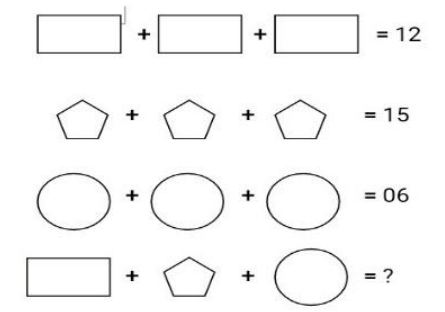
Study the given pattern carefully and select the number that can replace the question mark (?) in it.

Study the given pattern carefully and select the number from among the given options that can replace the question mark (?).
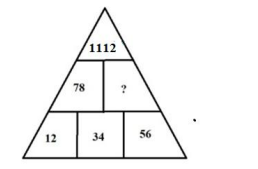
Study the given pattern carefully and select the number from the given options that can replace the question mark (?).
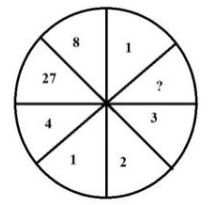
Study the given pattern carefully and select the number from among the given options that can replace the question mark (?).
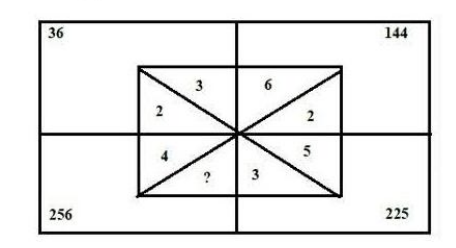
Study the given pattern carefully and select the number that can replace the question mark (?) in it
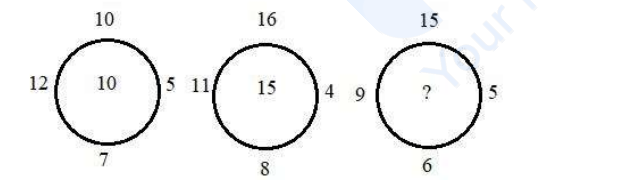
Study the given pattern carefully and select the number that can replace the question mark (?) in it.
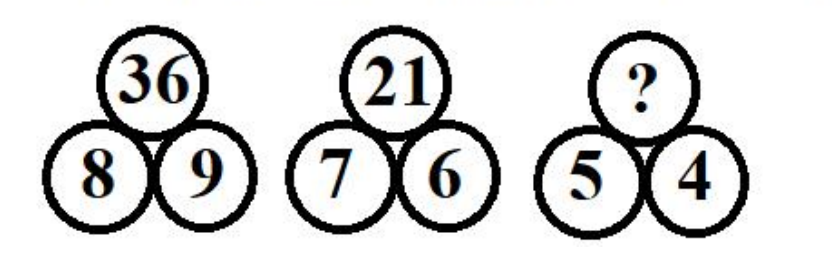
Study the given pattern carefully and select the number from among the given options that can replace the question mark (?).
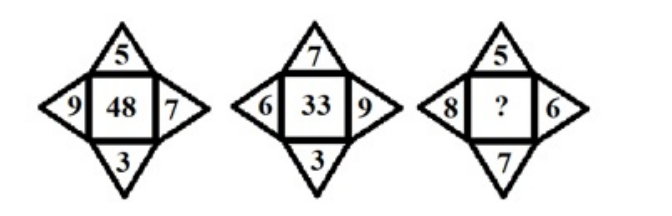
Important Questions from Missing Number
Study the given pattern carefully and select the number from among the given options that can replace the question mark (?) in it.
13 16 52 15 24 90 23 36 ? Select the set in which the numbers are related in the same way as are the numbers of the given set.
(NOTE: Operations should be performed on the whole numbers, without breaking down the number into its constituent digits.E.g. 13 - Operations on 13 such as adding /Subtracting /multiplying etc. to 13 can be performed. Breaking down 13 into 1 and 3 and then performing mathematical operations on 1 and 3 is not allowed.)
(25, 150, 3)
(18, 180, 5)
Select the option that is related to the fifth number in the same way as the second number is related to the first number and the fourth number is related to the third number.
7 ∶ 35 ∶∶ 21 ∶ 399 ∶∶ 4 ∶ ?
Study the given pattern carefully and select the number that can replace the question mark (?) in it.
First row - 12, 7, 32
Second row - 17, 13, 33
Third row - 14, 8, ?
(NOTE : Operations should be performed on the whole numbers, without breaking down the numbers into its constituent digits. E.g. 13 - Operations on 13 such as adding/subtracting/multiplying etc. to 13 can be performed. Breaking down 13 into 1 and 3 and then performing mathematical operations on 1 and 3 is NOT allowed)
Select the number that can replace the question mark (?) in the following pattern.
5
6
7
8
9
115
206
?
502
719



