
Methanol Poisoning Treatment Mechanism
The intravenous infusion of ethanol serves as an antidote for methanol poisoning by leveraging a specific enzyme inhibition mechanism.
Understanding Competitive Inhibition
Methanol is toxic because it is metabolized by the enzyme alcohol dehydrogenase (ADH) into harmful substances like formaldehyde. Ethanol is also a substrate for ADH, but it has a higher affinity for the enzyme compared to methanol.
- Ethanol binds preferentially to the active site of alcohol dehydrogenase.
- This binding prevents methanol from accessing the active site.
- By blocking methanol metabolism, ethanol significantly slows down the production of toxic metabolites.
- This allows the body more time to safely excrete the methanol.
This process, where a molecule (ethanol) competes with the normal substrate (methanol) for the enzyme's active site, is known as competitive inhibition.
Why Other Options Are Incorrect
- Non-competitive inhibition involves binding at a site other than the active site, which doesn't describe ethanol's action here.
- Mixed inhibition combines features of both, but the primary mechanism in this therapy is direct competition for the active site.
- Enzyme activation involves increasing enzyme activity, whereas ethanol's role here is inhibitory.
Therefore, the treatment mechanism relies fundamentally on competitive inhibition.
Important Questions from Enzyme Kinetics Competitive Inhibition
- The CORRECT statement(s) about a competitive inhibitor of an enzyme is/are
- For a simple enzyme that follows Michaelis-Menten kinetics, kinetic data was collected in the absence (dotted line, -I), or presence (solid line, +I) of an uncompetitive inhibitor (I). Which one of the following Eadie-Hofstee plots best describes the expected result?
($v_0$ = initial velocity, $[S]$ = free substrate concentration) - Researchers measure the activity of an enzyme in the presence of an inhibitor. They observe that
- $V_{\text{max}}$ of the enzyme remains unchanged at saturating substrate concentration
- $K_m$ increases compared to uninhibited enzyme
The kinetics of an enzyme in the presence (+I) or absence (-I) of a reversible inhibitor is described in the following graph.
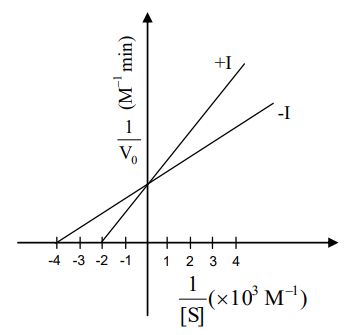
If concentration of the reversible inhibitor in +I experiment was equal to $3.0 \times 10^{-3}$ M, then the dissociation constant for the enzyme-inhibitor complex is
- In an in vitro dehydrogenation reaction of succinate catalyzed by succinate dehydrogenase, malonate is added. Which one of the following curves represents the effect of malonate on the catalysis of succinate dehydrogenase?


