
Six numbers, 1, 2, 3, 4, 5, and 6, are written on the different faces of a dice. Three different positions of the same dice are shown (Figures 1-3). Find the number on the face opposite to the face showing ‘3’.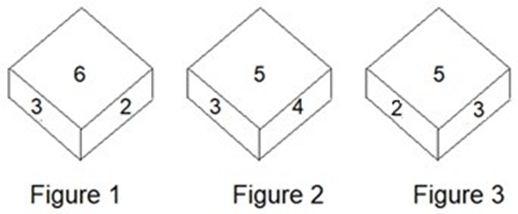
1
By analyzing the three given dice positions, we can observe which numbers are adjacent to '3'. The number that is not seen in any of these positions as an adjacent face is '1', meaning it is opposite to '3'.
Important Questions from Cube and Dice
A cube of side 80 cm is painted yellow on all the faces and then cut into smaller cubes of sides 8 cm each. Find the number of smaller cube having all the three faces painted.
A cube of side 49 cm is painted purple on all the faces and then cut into smaller cubes of sides 7 cm each. Find the number of smaller cubes having only one face printed.
A cube of side 18 cm is painted yellow on all the faces and then cut into smaller cubes of sides 3 cm each. Find the number of smaller cubes that have only two faces painted.
A cube of side 12 cm is painted green on all the faces and then cut into smaller cubes of sides 2 cm each. Find the number of smaller cubes that have only one face painted.
Four friends J, Q, B and Z rolled the dice in alphabetical order.
The scores were:
1st round: 3, 2, 5, 2
2nd round: 1, 5, 1, 4
3rd round: 4, 2, 1, 1
If each point on the dice would get 10 points, who won the maximum points after 3 rounds?


