Four friends J, Q, B and Z rolled the dice in alphabetical order. The scores were: 1st round: 3, 2, 5, 2 2nd round: 1, 5, 1, 4 3rd round: 4, 2, 1, 1 If each point on the dice would get 10 points, who won the maximum points after 3 rounds?
J
Analyzing Dice Rolling Scores to Find the Winner
The problem describes a scenario where four friends, J, Q, B, and Z, roll dice over three rounds. They roll in alphabetical order. This means the order of rolling is B, J, Q, and then Z. The scores for each round are provided in that specific order (1st score for B, 2nd for J, 3rd for Q, 4th for Z). We are also told that each point on the dice is worth 10 points. We need to calculate the total points for each friend over the three rounds and identify who earned the maximum points.
Step-by-Step Calculation of Total Dice Points
First, let's list the scores for each friend across the three rounds based on the rolling order (B, J, Q, Z) and the provided scores:
| Friend | Round 1 Score | Round 2 Score | Round 3 Score |
|---|---|---|---|
| B | 3 | 1 | 4 |
| J | 2 | 5 | 2 |
| Q | 5 | 1 | 1 |
| Z | 2 | 4 | 1 |
Now, let's calculate the total dice points for each friend by summing their scores from the three rounds:
- For friend B: Total dice points = $3 + 1 + 4 = 8$
- For friend J: Total dice points = $2 + 5 + 2 = 9$
- For friend Q: Total dice points = $5 + 1 + 1 = 7$
- For friend Z: Total dice points = $2 + 4 + 1 = 7$
Calculating Total Points Earned
Each point on the dice is worth 10 points. To find the total points for each friend, we multiply their total dice points by 10.
- For friend B: Total points = $8 \times 10 = 80$ points
- For friend J: Total points = $9 \times 10 = 90$ points
- For friend Q: Total points = $7 \times 10 = 70$ points
- For friend Z: Total points = $7 \times 10 = 70$ points
Identifying the Winner with Maximum Points
Now, let's compare the total points earned by each friend:
- B: 80 points
- J: 90 points
- Q: 70 points
- Z: 70 points
Comparing these scores, we can see that friend J earned the maximum points (90 points) after three rounds.
Conclusion
Based on the scores and the points system, J won the maximum points after 3 rounds of rolling the dice.
Revision Table: Dice Game Scores and Points
| Friend | Scores (R1, R2, R3) | Total Dice Points | Total Points (Total Dice Points x 10) |
|---|---|---|---|
| B | 3, 1, 4 | 8 | 80 |
| J | 2, 5, 2 | 9 | 90 |
| Q | 5, 1, 1 | 7 | 70 |
| Z | 2, 4, 1 | 7 | 70 |
Additional Information: Understanding Quantitative Problems
Quantitative problems often involve extracting numerical data from a description, performing calculations, and interpreting the results. In this dice rolling scenario, the key steps were:
- Identifying the participants and their order.
- Mapping the scores provided to the correct participant for each round.
- Summing individual scores over multiple rounds.
- Applying a conversion factor (points per dice point) to calculate final scores.
- Comparing final scores to determine the highest value.
Such problems test attention to detail in reading the question and accuracy in basic arithmetic operations like addition and multiplication.
Important Questions from Cube and Dice
A cube of side 80 cm is painted yellow on all the faces and then cut into smaller cubes of sides 8 cm each. Find the number of smaller cube having all the three faces painted.
A cube of side 49 cm is painted purple on all the faces and then cut into smaller cubes of sides 7 cm each. Find the number of smaller cubes having only one face printed.
A cube of side 18 cm is painted yellow on all the faces and then cut into smaller cubes of sides 3 cm each. Find the number of smaller cubes that have only two faces painted.
A cube of side 12 cm is painted green on all the faces and then cut into smaller cubes of sides 2 cm each. Find the number of smaller cubes that have only one face painted.
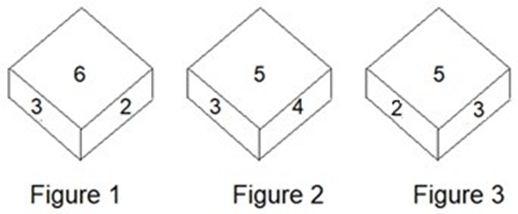
Six numbers, 1, 2, 3, 4, 5, and 6, are written on the different faces of a dice. Three different positions of the same dice are shown (Figures 1-3). Find the number on the face opposite to the face showing ‘3’.