A cube of side 80 cm is painted yellow on all the faces and then cut into smaller cubes of sides 8 cm each. Find the number of smaller cube having all the three faces painted.
8
Understanding Painted Cubes: Three Painted Faces
This problem involves a large cube that is painted on all its faces and then cut into smaller, identical cubes. We need to determine how many of these smaller cubes have exactly three of their faces painted.
When a large cube is cut into smaller cubes, the smaller cubes can have:
- Three faces painted
- Two faces painted
- One face painted
- Zero faces painted
Let's analyze where each type of smaller cube is located within the original large cube.
Identifying Cubes with Three Painted Faces
A smaller cube will have three faces painted if and only if it was originally located at a corner of the large cube. This is because each corner of the large cube exposes three faces to the outside, which are then painted.
A standard cube has a specific number of corners.
- Number of corners in a cube: 8
Therefore, each of these 8 corners will yield one smaller cube with three painted faces.
Calculating the Number of Smaller Cubes along Each Edge
The side length of the large cube is 80 cm.
The side length of each smaller cube is 8 cm.
To find the number of smaller cubes along one edge of the large cube, we divide the side length of the large cube by the side length of the smaller cube:
\( \text{Number of smaller cubes along an edge} = \frac{\text{Side of large cube}}{\text{Side of small cube}} \)
\( \text{Number along edge} = \frac{80 \text{ cm}}{8 \text{ cm}} = 10 \)
So, there are 10 smaller cubes along each edge of the large cube.
Determining the Total Number of Cubes with Three Painted Faces
As established, the smaller cubes with three painted faces are those located at the corners of the original large cube.
Since a cube has 8 corners, there will be 8 smaller cubes with three painted faces.
The number of smaller cubes with three painted faces is equal to the number of corners of the large cube.
\( \text{Number of cubes with 3 painted faces} = \text{Number of corners} = 8 \)
Thus, there are 8 smaller cubes that have all three faces painted.
Revision Table: Painted Cubes
| Type of Painted Face | Location in Large Cube | Formula (for n small cubes along edge) | Number for n=10 |
|---|---|---|---|
| Three faces painted | Corners | 8 | 8 |
| Two faces painted | Edges (excluding corners) | \(12 \times (n-2)\) | \(12 \times (10-2) = 12 \times 8 = 96\) |
| One face painted | Faces (excluding edges/corners) | \(6 \times (n-2)^2\) | \(6 \times (10-2)^2 = 6 \times 8^2 = 6 \times 64 = 384\) |
| Zero faces painted | Interior | \((n-2)^3\) | \((10-2)^3 = 8^3 = 512\) |
Additional Information: Cube Cutting Concepts
Problems involving cutting a large painted cube into smaller cubes are common in spatial reasoning and quantitative aptitude tests. The key is to understand how the position of a smaller cube within the original large cube determines the number of its painted faces.
- Corners: Always have 3 faces painted. There are always 8 corners on any cube.
- Edges (not corners): Have 2 faces painted. These are the small cubes along the edges of the large cube, but not at the very ends (corners).
- Faces (not edges/corners): Have 1 face painted. These are the small cubes in the center of each face of the large cube.
- Interior: Have 0 faces painted. These cubes are entirely inside the large cube and were not exposed to the paint.
If the large cube is divided into \(n \times n \times n\) smaller cubes (where \(n\) is the number of small cubes along each edge), the number of small cubes with different numbers of painted faces can be calculated using the formulas provided in the table above, where \( n = \frac{\text{Side of large cube}}{\text{Side of small cube}} \).
Important Questions from Cube and Dice
A cube of side 49 cm is painted purple on all the faces and then cut into smaller cubes of sides 7 cm each. Find the number of smaller cubes having only one face printed.
A cube of side 18 cm is painted yellow on all the faces and then cut into smaller cubes of sides 3 cm each. Find the number of smaller cubes that have only two faces painted.
A cube of side 12 cm is painted green on all the faces and then cut into smaller cubes of sides 2 cm each. Find the number of smaller cubes that have only one face painted.
Four friends J, Q, B and Z rolled the dice in alphabetical order.
The scores were:
1st round: 3, 2, 5, 2
2nd round: 1, 5, 1, 4
3rd round: 4, 2, 1, 1
If each point on the dice would get 10 points, who won the maximum points after 3 rounds?
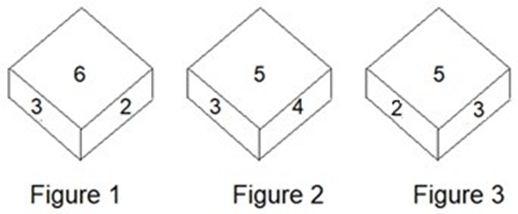
Six numbers, 1, 2, 3, 4, 5, and 6, are written on the different faces of a dice. Three different positions of the same dice are shown (Figures 1-3). Find the number on the face opposite to the face showing ‘3’.