Pollination Definition and Explanation
The question asks to identify the correct statement describing pollination. Pollination is a fundamental process in the sexual reproduction of flowering plants. Let's analyze each option to understand the concept better.
Understanding Pollination
Pollination is the process that leads to fertilization and the production of seeds, fruits, and new plants. It involves the movement of male gametes (in the form of pollen) from the male part of a flower to the female part of the flower.
Analysis of Options
-
Option 1: Pollination is transfer of pollen grains from stamen to stigma.
This statement accurately defines pollination. The stamen is the male reproductive part of a flower, which produces pollen grains. The stigma is the receptive tip of the female reproductive organ (pistil or carpel). The transfer of pollen grains from the anther (part of the stamen) to the stigma is precisely what pollination is.
-
Option 2: Pollination is the growth of pollen tube in ovule.
This statement is incorrect. The growth of a pollen tube from the pollen grain down towards the ovule occurs after pollination has taken place and the pollen grain has germinated on the stigma. This process is part of fertilization, not pollination itself.
-
Option 3: Pollination is visit of insects to the flower.
This statement describes an agent or mechanism of pollination, not the process itself. Insects, wind, water, and animals are often involved in transferring pollen grains (these are called pollinators), but the visit itself is not the definition of pollination.
-
Option 4: Pollination is germination of pollen grains.
This statement is also incorrect. Pollen grain germination happens on the stigma following successful pollination. Germination is the process where the pollen grain sprouts a pollen tube to reach the ovule for fertilization. It is a consequence of pollination, not the definition of it.
Conclusion
Based on the analysis, the only statement that correctly defines the biological process of pollination is the transfer of pollen grains from the stamen to the stigma.
Important Questions from General
Match List-I with List-II and select the answer using the codes given below the Lists :
List-I
(Forest Research Institute)
List-II
(Location)
A. Tropical Forest Research Institute 1. Prayagraj B. Rain Forest Research Institute 2. Jorhat C. Himalayan Forest Research Institute 3. Jabalpur D. Forest Research Centre for Eco-Rehabilitation 4. Shimla
Codes :- In which of the following years was the School of Minerals, Metallurgical and Materials Engineering (SMMME) established at Bhubaneswar?
Three of the following numbers are alike in a certain way and one is different. Pick the odd one out.
(NOTE: Operations should be performed on the whole numbers, without breaking down the numbers into its constituent digits. E.g. 13 – Operations on 13 such as adding/deleting/multiplying etc., to 13 can be performed. Breaking down 13 into 1 and 3 and then performing mathematical operations on 1 and 3 is not allowed.)
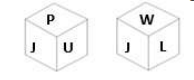
Six letters P, J, U, W, L, and K are written on different faces of a dice. Two positions of this dice are shown in the figures below. Find the letter on the face opposite to P.