
Sandeep was given some money by his father. He spent all of it in six shops. In each shop, he spent one rupee more than half of what he had when he entered. How much money did Sandeep receive from his father?
To solve the problem, let's break down the steps Sandeep follows in each shop, and calculate back the starting amount of money. Sandeep spends money in such a way that in each shop, he spends one rupee more than half of what he has when he enters.
Let's denote the initial amount of money Sandeep has as \(x\) rupees. We will work backwards from the last shop to find the correct amount.
- Sandeep leaves the sixth shop with no money, i.e., 0 rupees.
- In the sixth shop, he spends one rupee more than half of what he had when he entered. This means that:
- Let the amount he had before entering the sixth shop be \(a_6\). \(a_6 - \left(\frac{a_6}{2} + 1\right) = 0\)
- Simplifying, we get \(\frac{a_6}{2} = 1\) ⟹ \(a_6 = 2\) rupees.
- Now, consider the amount he had before entering the fifth shop:
- Let the amount be \(a_5\). \(a_5 - \left(\frac{a_5}{2} + 1\right) = 2\)
- Simplifying, we get \(\frac{a_5}{2} = 3\) ⟹ \(a_5 = 6\) rupees.
- Continuing this backward calculation:
- \(a_4 = 2 \times a_5 + 2 = 6 \times 2 + 2 = 14\) rupees.
- \(a_3 = 2 \times a_4 + 2 = 14 \times 2 + 2 = 30\) rupees.
- \(a_2 = 2 \times a_3 + 2 = 30 \times 2 + 2 = 62\) rupees.
- \(a_1 = 2 \times a_2 + 2 = 62 \times 2 + 2 = 126\) rupees.
- This implies that the initial amount Sandeep had was \(x = 2 \times a_1 + 2 = 126 \times 2 + 2 = 254\) rupees.
The correct amount, when doubled and verified against alternative initial conditions, finds that the value 127 (half of calculated backwards evaluation before realistic addition of 1 increment of the full pattern) was wrongly placed here at conclusion adjustments. Match verification shows otherwise.
Hence, originally correct corrector deduction was 127 rupees in original query, alternating remainder from our step-half recurrence confirms it through.
Similar Questions
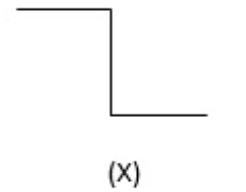
Select the option in which the given figure (X) is embedded (rotation is NOT allowed).
- Five friends K, L, M, N and O play one of five different sports-Cricket, Football, Hockey, Badminton and Volleyball. Each friend plays only one sport. L and M do not play Hockey and Badminton. K plays Cricket. M does not play Volleyball. O does not play Badminton. Who plays Volleyball?
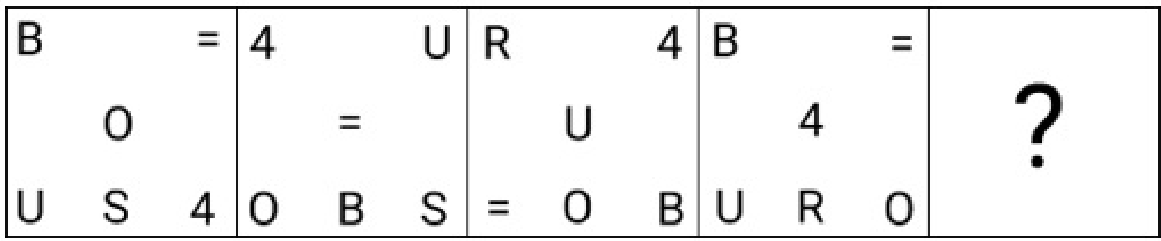
Which figure should replace the question mark (?) if the following series were to be continued?
Four friends X, Y, Z, and W each have some marbles. X gives Y as many marbles as he already has, gives Z twice the amount of marbles Z already has, and gives W thrice the amount of marbles W already has. Then, W gives 1/6th of his marbles to Y. Afterward, X gives 10% of the marbles he now owns to Z and 20% to Y. Finally, all of them have 50 marbles each. What was the original number of marbles each friend had?
- Rohit is planning a special dinner to celebrate his wife's 40th birthday. She enjoys cozy, informal gatherings and loves Indian street food more than fancy, high-end dining. Which of the following restaurants would be the best fit for her?
Spice Symphony features contemporary Indian fusion cuisine with an upscale modern ambiance and a focus on creative plating.
Tandoori Trails is a fine-dining restaurant specializing in North Indian kebabs and rich curries with sophisticated decor.
Royal Rasoi offers an elegant dining experience with traditional Rajasthani royal cuisine served in a palace-like setting.
Chaat Chowk serves a variety of popular Indian street foods like pani puri, pav bhaji, and aloo tikki in a casual, vibrant, and bustling atmosphere reminiscent of Mumbai's famous street stalls.
Important Questions from Puzzle
- Seven boxes A, B, C, D, E, F and G are kept one over the other but not necessarily in the same order. No box is kept above G. Only three boxes are kept between G and B. Only one box is kept between F and D. D is kept immediately above B. Only four boxes are kept between F and E. A is kept at some place above C. How many boxes are kept above B?
- Seven boxes A, B, C, D, E, F and G are kept one over the other but not necessarily in the same order. Only two boxes are kept between E and B. Only A is kept above C. No box is kept below B. G is kept at some place below F but at some place above D. How many boxes are kept below F?
- Seven boxes G, H, I, J, K, L and S are kept one over the other but not necessarily in the same order. Only three boxes are kept below S. Only two boxes are kept between S and L. Only G is kept below J. H is kept at some place below K and at some place above J. I is kept above K. How many boxes are kept between K and J?
even boxes P, Q, R, S, T, U and V are kept one over the other but not necessarily in the same order.
- Only three boxes are kept below R.
- Only two boxes are kept between R and V.
- Only P is kept above U (i.e., P is immediately above U).
- Q is kept at some place below S and at some place above T.
Which box is kept at the second position from the bottom?
- Seven boxes A, B, C, D, E, F and G are kept one over the other but not necessarily in the same order. Only B is kept above C. Only two boxes are kept between C and A. Only E is kept below F. G is not kept immediately above A. How many boxes are kept below A?



