
Right triangle PQR is to be constructed in the xy - plane so that the right angle is at P and line PR is parallel to the x-axis. The x and y coordinates of P, Q, and R are to be integers that satisfy the inequalities: $-4\le x \le 5$ and $6 \le y \le 16$. How many different triangles could be constructed with these properties?
Problem Analysis
The question asks for the number of unique right triangles PQR that can be constructed under specific conditions:
- The right angle is at vertex P.
- Side PR is parallel to the x-axis.
- All coordinates (x, y) of P, Q, and R must be integers.
- The coordinates must satisfy the inequalities: $-4 ≤ x ≤ 5$ and $6 ≤ y ≤ 16$.
Coordinate Constraints
First, determine the number of possible integer values for x and y coordinates:
- X-coordinates: Integers from -4 to 5 inclusive. The total number of possible x-values is $5 - (-4) + 1 = 10$.
- Y-coordinates: Integers from 6 to 16 inclusive. The total number of possible y-values is $16 - 6 + 1 = 11$.
Triangle Properties and Point Relationships
Given that the right angle is at P and PR is parallel to the x-axis:
- This means PR is a horizontal segment. Therefore, P and R must have the same y-coordinate. Let $P = (x_P, y_P)$ and $R = (x_R, y_P)$.
- Since PQ must be perpendicular to PR (the horizontal segment PR), PQ must be a vertical segment. Therefore, P and Q must have the same x-coordinate. Let $Q = (x_P, y_Q)$.
- Also, for a valid triangle, the vertices must be distinct. This means $x_R \ne x_P$ and $y_Q \ne y_P$.
Solution Steps
Step 1: Determine the number of choices for vertex P.
P has coordinates $(x_P, y_P)$.
- Number of choices for $x_P$: 10 (any integer from -4 to 5).
- Number of choices for $y_P$: 11 (any integer from 6 to 16).
- Total number of possible points for P = (Choices for $x_P$) $\times$ (Choices for $y_P$) = $10 \times 11 = 110$.
Step 2: Determine the number of choices for vertex R, given P.
R has coordinates $(x_R, y_P)$. R shares the same y-coordinate as P ($y_P$).
- The x-coordinate $x_R$ must be different from $x_P$.
- Number of choices for $x_R$: Total x-choices minus 1 (excluding $x_P$) = $10 - 1 = 9$.
- The y-coordinate $y_R$ is fixed ($y_R = y_P$).
- Number of choices for R for a fixed P = 9.
Step 3: Determine the number of choices for vertex Q, given P.
Q has coordinates $(x_P, y_Q)$. Q shares the same x-coordinate as P ($x_P$).
- The y-coordinate $y_Q$ must be different from $y_P$.
- Number of choices for $y_Q$: Total y-choices minus 1 (excluding $y_P$) = $11 - 1 = 10$.
- The x-coordinate $x_Q$ is fixed ($x_Q = x_P$).
- Number of choices for Q for a fixed P = 10.
Step 4: Calculate the total number of different triangles.
The total number of triangles is the product of the number of choices for P, the number of choices for R (given P), and the number of choices for Q (given P).
Total Triangles = (Number of choices for P) $\times$ (Number of choices for R) $\times$ (Number of choices for Q)
Total Triangles = $110 \times 9 \times 10 = 9900$.
Alternatively, we can think of choosing the coordinates directly:
Total Triangles = (Choices for $x_P$) $\times$ (Choices for $y_P$) $\times$ (Choices for $x_R \ne x_P$) $\times$ (Choices for $y_Q \ne y_P$)
Total Triangles = $10 \times 11 \times 9 \times 10 = 9900$.
Conclusion
There are 9,900 different right triangles that can be constructed with the given properties and constraints.
Important Questions from Mensuration and Geometry
In the given figure, $P, Q$, and $R$ are three points on a circle of radius 10 cm with $O$ as its center, $\overline{PQ} = \overline{RQ}$, and $\angle PQR = 45^\circ$. The figure is representative.
The area of the shaded region $PQRO$ is ______________ cm$^2$.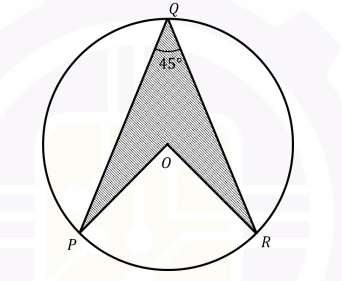
- A straight line $y = x - 1$ intersects a circle with center at $x = 1, y = 1$ and radius of magnitude 1 at two points. The length of the chord formed by this intersection is _______. (rounded off to three decimal places)
- The shell of a hollow spherical nanoparticle has a uniform thickness of 3 nanometers (nm). The outer radius of the nanoparticle is 5 nm. The ratio of the volume of the shell to the volume of the hollow core is ________
(Round off to one decimal place) - The volume of a sphere of diameter 1 unit is ______ than the volume of a cube of side 1 unit.
- A window is made up of a square portion and an equilateral triangle portion above it. The base of the triangular portion coincides with the upper side of the square. If the perimeter of the window is 6 m, the area of the window in $m^2$ is ______


