
Geometry: Chord Length Calculation
We need to find the length of the chord formed by the intersection of the line $y = x - 1$ and the circle with center $(1, 1)$ and radius $r = 1$. We can use the relationship between the radius, the distance from the circle's center to the chord, and half the chord length.
Distance from Center to Chord
First, rewrite the line equation in the general form $Ax + By + C = 0$: $x - y - 1 = 0$. The center of the circle is $(x_0, y_0) = (1, 1)$. The radius is $r = 1$. The distance ($d$) from the center $(1, 1)$ to the line $x - y - 1 = 0$ is calculated using the formula:
$d = \frac{|Ax_0 + By_0 + C|}{\sqrt{A^2 + B^2}}$ $d = \frac{|1(1) + (-1)(1) + (-1)|}{\sqrt{1^2 + (-1)^2}}$ $d = \frac{|1 - 1 - 1|}{\sqrt{1 + 1}}$ $d = \frac{|-1|}{\sqrt{2}} = \frac{1}{\sqrt{2}}$
Chord Length Calculation
Let the length of the chord be $L$. The radius ($r$), the distance ($d$), and half the chord length ($L/2$) form a right-angled triangle, with the radius as the hypotenuse.
Using the Pythagorean theorem:
$r^2 = d^2 + (L/2)^2$ $1^2 = \left(\frac{1}{\sqrt{2}}\right)^2 + (L/2)^2$ $1 = \frac{1}{2} + (L/2)^2$
Now, solve for $(L/2)^2$:
$(L/2)^2 = 1 - \frac{1}{2} = \frac{1}{2}$
Find $L/2$:
$L/2 = \sqrt{\frac{1}{2}} = \frac{1}{\sqrt{2}}
Finally, calculate the full chord length $L$:
$L = 2 \times (L/2) = 2 \times \frac{1}{\sqrt{2}} = \sqrt{2}$
Final Result
The length of the chord is $\sqrt{2}$. Rounded to three decimal places, this is $1.414$.
Important Questions from Mensuration and Geometry
In the given figure, $P, Q$, and $R$ are three points on a circle of radius 10 cm with $O$ as its center, $\overline{PQ} = \overline{RQ}$, and $\angle PQR = 45^\circ$. The figure is representative.
The area of the shaded region $PQRO$ is ______________ cm$^2$.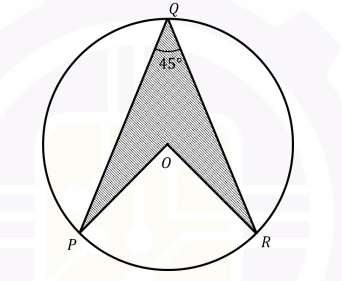
- The shell of a hollow spherical nanoparticle has a uniform thickness of 3 nanometers (nm). The outer radius of the nanoparticle is 5 nm. The ratio of the volume of the shell to the volume of the hollow core is ________
(Round off to one decimal place) - The volume of a sphere of diameter 1 unit is ______ than the volume of a cube of side 1 unit.
- A window is made up of a square portion and an equilateral triangle portion above it. The base of the triangular portion coincides with the upper side of the square. If the perimeter of the window is 6 m, the area of the window in $m^2$ is ______
Right triangle PQR is to be constructed in the xy - plane so that the right angle is at P and line PR is parallel to the x-axis. The x and y coordinates of P, Q, and R are to be integers that satisfy the inequalities: $-4\le x \le 5$ and $6 \le y \le 16$. How many different triangles could be constructed with these properties?


