Quinolones Interference with Bacterial Processes
Quinolones are a class of synthetic antimicrobial agents. Their primary mechanism of action is to target essential enzymes involved in bacterial DNA management.
Mechanism of Action
Quinolones specifically inhibit two key bacterial enzymes:
- DNA gyrase (Bacterial Topoisomerase II): This enzyme is crucial for relieving torsional stress during DNA replication and transcription by introducing negative supercoils into the bacterial DNA.
- Topoisomerase IV: This enzyme is primarily responsible for decatenating (unlinking) replicated daughter DNA chromosomes, allowing them to segregate properly before cell division.
By inhibiting these enzymes, quinolones disrupt the normal processes of DNA replication, repair, and transcription. This leads to DNA strand breakage and prevents the bacteria from multiplying.
Target Process
The direct effect of quinolone action is the disruption of bacterial nucleic acid synthesis. They do not affect viral nucleic acid synthesis or protein synthesis in bacteria.
Conclusion
Therefore, quinolones act on/interfere with Bacterial nucleic acid synthesis.
Similar Questions
- Which of the following statements are true about effective mass?
A. Effective mass arises due to interaction of electrons with periodic potential of lattice
B. The curvature of the band determines the electron effective mass
C. Effective mass cannot be negative
D. The calculation of effective mass takes into account the shape of energy bands in 3-D k-space
E. Effective mass of an electron is given by $\text{m}^{*} = \frac{\hbar}{\left( \frac{\text{d}^{2}\text{E}}{\text{d}\text{k}^{2}} \right)}$
Choose the correct answer from the options given below : - Match List - I with List - II.
List - I List - II A. Bloch wall I. Directs the magnetisation along directions of easy magnetisaton B. Anisotropy energy II. Above which the susceptibility of a ferromagnetic material obeys Curie-Weiss Law C. Magnon III. Separates domains magnetised in different directions D. Curie Temperature IV. Quantised spin wave
Choose the correct answer from the options given below : Match List - I with List - II.
List - I (System) List - II (Density of States) A. Bulk semiconductor I. 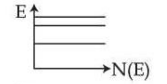
B. Quantum well II. 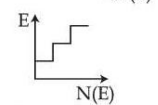
C. Quantum wire III. 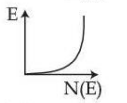
D. Quantum dot IV. 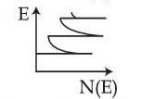
Choose the correct answer from the options given below :- Match List - I with List - II.
List - I (Type) List - II (Examples) A. Diamagnetic Materials I. Aluminium, Sodium, Calcium B. Paramagnetic Materials II. $\text{SrTiO}_{3-x}$, $\text{LiTi}_{2}\text{O}_{4}$, $\text{Ba}(\text{Pb, Bi})\text{O}_{3}$ C. Ferromagnetic Materials III. Bismuth, Copper, lead D. High temperature superconductors IV. Alnico
Choose the correct answer from the options given below : - Match List - I with List - II.
List - I List - II A. Young's Modulus I. $\frac{-\text{V}\text{d}\text{P}}{\text{d}\text{V}}$ B. Bulk Modulus II. $\frac{-\Delta\text{d}/\text{d}}{\Delta\text{L}/\text{L}}$ C. Modulus of Rigidity III. $\frac{\text{FL}}{\text{A}\Delta\text{L}}$ D. Poisson Ratio IV. $\frac{\text{F}/\text{A}}{x/h}$
Choose the correct answer from the options given below : - How many base pairs are in a haploid set of human chromosomes :
- CD in Immunology is :
- First licensed vaccine generated by reverse vaccinology is :
- Etiological agent of Malaria is a :
- The opening and closing of stomota is controlled by a hormone called :
Important Questions from Miscellaneous
- Which of the following scheduler/schedulers is/are also called CPU scheduler ?
(A). Short Term Scheduler
(B). Long Term Scheduler
(C). Medium Term Scheduler
(D). Asymmetric Scheduler
Choose the correct answer from the options given below: - A situation where two or more processes are blocked, waiting for resources held by each other is called:
- External fragmentation occurs ________.
- Which disk scheduling algorithm looks for the track closest to the current head position?
- Which CPU scheduling algorithm prefers the process with the shortest burst time?