
List - I List - II A. Young's Modulus I. $\frac{-\text{V}\text{d}\text{P}}{\text{d}\text{V}}$ B. Bulk Modulus II. $\frac{-\Delta\text{d}/\text{d}}{\Delta\text{L}/\text{L}}$ C. Modulus of Rigidity III. $\frac{\text{FL}}{\text{A}\Delta\text{L}}$ D. Poisson Ratio IV. $\frac{\text{F}/\text{A}}{x/h}$
Choose the correct answer from the options given below :
Elasticity Concepts Matching
This question requires matching different elastic moduli and Poisson's ratio with their defining mathematical expressions.
Matching List I with List II
A. Young's Modulus
Young's Modulus measures the stiffness of a material under tensile or compressive stress. It is defined as the ratio of longitudinal stress to longitudinal strain.
Formula: $Y = \frac{\text{Stress}}{\text{Strain}} = \frac{F/A}{\Delta L/L}$
This corresponds to term III.
B. Bulk Modulus
Bulk Modulus quantifies a substance's resistance to uniform compression. It is the ratio of pressure change to the relative volume change.
Formula: $B = -\frac{\Delta P}{\Delta V / V}$ or in differential form $B = \frac{-\text{V dP}}{\text{dV}}$
This corresponds to term I.
C. Modulus of Rigidity
The Modulus of Rigidity (or Shear Modulus) describes a solid's resistance to shearing forces. It is the ratio of shear stress to shear strain.
Formula: $G = \frac{\text{Shear Stress}}{\text{Shear Strain}} = \frac{F/A}{x/h}$
This corresponds to term IV.
D. Poisson Ratio
Poisson's Ratio is the ratio of transverse strain (perpendicular to the applied force) to axial strain (parallel to the applied force).
Formula: $\nu = -\frac{\text{Transverse Strain}}{\text{Axial Strain}} = \frac{-\Delta d/d}{\Delta L/L}$
This corresponds to term II.
Correct Match
Based on the definitions:
- A matches with III
- B matches with I
- C matches with IV
- D matches with II
Therefore, the correct matching is A-III, B-I, C-IV, D-II.
Similar Questions
- Which of the following statements are true about effective mass?
A. Effective mass arises due to interaction of electrons with periodic potential of lattice
B. The curvature of the band determines the electron effective mass
C. Effective mass cannot be negative
D. The calculation of effective mass takes into account the shape of energy bands in 3-D k-space
E. Effective mass of an electron is given by $\text{m}^{*} = \frac{\hbar}{\left( \frac{\text{d}^{2}\text{E}}{\text{d}\text{k}^{2}} \right)}$
Choose the correct answer from the options given below : - Match List - I with List - II.
List - I List - II A. Bloch wall I. Directs the magnetisation along directions of easy magnetisaton B. Anisotropy energy II. Above which the susceptibility of a ferromagnetic material obeys Curie-Weiss Law C. Magnon III. Separates domains magnetised in different directions D. Curie Temperature IV. Quantised spin wave
Choose the correct answer from the options given below : Match List - I with List - II.
List - I (System) List - II (Density of States) A. Bulk semiconductor I. 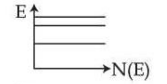
B. Quantum well II. 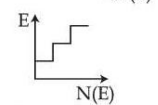
C. Quantum wire III. 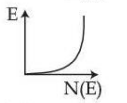
D. Quantum dot IV. 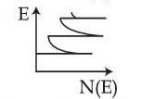
Choose the correct answer from the options given below :- Match List - I with List - II.
List - I (Type) List - II (Examples) A. Diamagnetic Materials I. Aluminium, Sodium, Calcium B. Paramagnetic Materials II. $\text{SrTiO}_{3-x}$, $\text{LiTi}_{2}\text{O}_{4}$, $\text{Ba}(\text{Pb, Bi})\text{O}_{3}$ C. Ferromagnetic Materials III. Bismuth, Copper, lead D. High temperature superconductors IV. Alnico
Choose the correct answer from the options given below : - How many base pairs are in a haploid set of human chromosomes :
- CD in Immunology is :
- First licensed vaccine generated by reverse vaccinology is :
- Etiological agent of Malaria is a :
- The opening and closing of stomota is controlled by a hormone called :
- Quinolones act on/interfere the :
Important Questions from Miscellaneous
- Which of the following scheduler/schedulers is/are also called CPU scheduler ?
(A). Short Term Scheduler
(B). Long Term Scheduler
(C). Medium Term Scheduler
(D). Asymmetric Scheduler
Choose the correct answer from the options given below: - A situation where two or more processes are blocked, waiting for resources held by each other is called:
- External fragmentation occurs ________.
- Which disk scheduling algorithm looks for the track closest to the current head position?
- Which CPU scheduling algorithm prefers the process with the shortest burst time?



