
Question
CD in Immunology is :
This question was previously asked in
CUET PG 2026 Agri-Business Management Question Paper (25-Mar-2026) (Shift 2)
The correct answer is
Cluster of differentiation
CD Meaning in Immunology
In immunology, "CD" is an acronym that stands for Cluster of Differentiation.
CD markers are specific cell surface proteins used to identify and classify cells, particularly cells of the immune system like lymphocytes and leukocytes.
These markers help researchers and clinicians:
- Distinguish between different types of immune cells.
- Track the stages of cell development and differentiation.
- Characterize specific cell populations for diagnostic purposes.
For example, CD4 and CD8 are well-known markers for T helper cells and cytotoxic T cells, respectively. The other options provided, such as Compact disc, Coronary disease, or Cause of death, do not represent the meaning of CD in an immunological context.
Was this answer helpful?
Similar Questions
- Which of the following statements are true about effective mass?
A. Effective mass arises due to interaction of electrons with periodic potential of lattice
B. The curvature of the band determines the electron effective mass
C. Effective mass cannot be negative
D. The calculation of effective mass takes into account the shape of energy bands in 3-D k-space
E. Effective mass of an electron is given by $\text{m}^{*} = \frac{\hbar}{\left( \frac{\text{d}^{2}\text{E}}{\text{d}\text{k}^{2}} \right)}$
Choose the correct answer from the options given below : - Match List - I with List - II.
List - I List - II A. Bloch wall I. Directs the magnetisation along directions of easy magnetisaton B. Anisotropy energy II. Above which the susceptibility of a ferromagnetic material obeys Curie-Weiss Law C. Magnon III. Separates domains magnetised in different directions D. Curie Temperature IV. Quantised spin wave
Choose the correct answer from the options given below : Match List - I with List - II.
List - I (System) List - II (Density of States) A. Bulk semiconductor I. 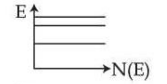
B. Quantum well II. 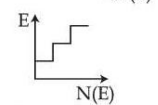
C. Quantum wire III. 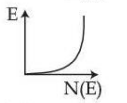
D. Quantum dot IV. 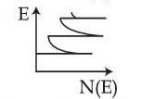
Choose the correct answer from the options given below :- Match List - I with List - II.
List - I (Type) List - II (Examples) A. Diamagnetic Materials I. Aluminium, Sodium, Calcium B. Paramagnetic Materials II. $\text{SrTiO}_{3-x}$, $\text{LiTi}_{2}\text{O}_{4}$, $\text{Ba}(\text{Pb, Bi})\text{O}_{3}$ C. Ferromagnetic Materials III. Bismuth, Copper, lead D. High temperature superconductors IV. Alnico
Choose the correct answer from the options given below : - Match List - I with List - II.
List - I List - II A. Young's Modulus I. $\frac{-\text{V}\text{d}\text{P}}{\text{d}\text{V}}$ B. Bulk Modulus II. $\frac{-\Delta\text{d}/\text{d}}{\Delta\text{L}/\text{L}}$ C. Modulus of Rigidity III. $\frac{\text{FL}}{\text{A}\Delta\text{L}}$ D. Poisson Ratio IV. $\frac{\text{F}/\text{A}}{x/h}$
Choose the correct answer from the options given below : - How many base pairs are in a haploid set of human chromosomes :
- First licensed vaccine generated by reverse vaccinology is :
- Etiological agent of Malaria is a :
- The opening and closing of stomota is controlled by a hormone called :
- Quinolones act on/interfere the :
Important Questions from Miscellaneous
- Which of the following scheduler/schedulers is/are also called CPU scheduler ?
(A). Short Term Scheduler
(B). Long Term Scheduler
(C). Medium Term Scheduler
(D). Asymmetric Scheduler
Choose the correct answer from the options given below: - A situation where two or more processes are blocked, waiting for resources held by each other is called:
- External fragmentation occurs ________.
- Which disk scheduling algorithm looks for the track closest to the current head position?
- Which CPU scheduling algorithm prefers the process with the shortest burst time?
Need Expert Advice?
Upcoming Exams
GATE
February 06, 2027
Test Series

CUET
CUET PG Psychology (HUQP20) 2026 Mock Test Series
10 Tests
753 Attempts
3.7(14)
English
More Questions from CUET PG


