
Question
Out of following, which one can be considered as the best reference point in a stratigraphic section?
The correct answer is
A tephra deposit
Stratigraphic Reference Points Explained
A reference point in a stratigraphic section, often called a marker horizon or datum, needs specific characteristics to be effective for correlating rock layers across different locations. The ideal marker is:
- Distinct and easily recognizable.
- Widespread geographically.
- Deposited rapidly, representing a specific point in time.
- Potentially datable using radiometric or other methods.
Evaluating Deposit Types
Let's examine how the given options fit these criteria:
- Turbidity deposits: These often form from underwater landslides or sediment flows. While they can be widespread in certain basin settings, their character can vary significantly, making them less reliable as a single, consistent marker.
- Tsunami deposits: Tsunamis create distinct deposits, but their preservation and lateral extent can be highly variable depending on coastal and marine environments.
- Limestone deposits: Limestones can form over long periods through various processes (e.g., biological activity, chemical precipitation). While thick limestone units can be mapped, a specific limestone bed is often not tied to a single, short-duration event, making it less precise as a time marker compared to others.
- Tephra deposits: These are layers of volcanic ash ejected during an eruption.
Why Tephra Deposits are Superior Markers
Tephra deposits stand out as the best reference points because:
- Rapid Deposition: They are laid down quickly during a single volcanic event.
- Widespread Distribution: Ash can travel vast distances, allowing correlation across large areas.
- Unique Composition: The chemical fingerprint of the ash is specific to the source volcano and eruption, aiding identification.
- Datability: Minerals within the ash (like zircons) can often be directly dated using radiometric techniques, providing absolute age control.
Therefore, a tephra deposit serves as an excellent, time-specific marker horizon in stratigraphic studies.
Was this answer helpful?
Important Questions from Principles Of Stratigraphy
- Which one of the following molecules is the most buoyant in the atmosphere?
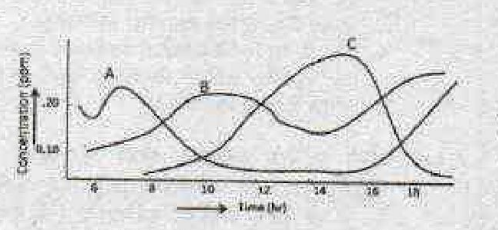
In the above diagram, A, B and C represent, respectively, the tropospheric concentrations of
- Oxygen atom required to form tropospheric ozone comes from
- Atmospheric layers where convection takes place are
Radiocarbon, used for dating sediments, is produced at the top of the Earth's atmosphere by the
Need Expert Advice?


