
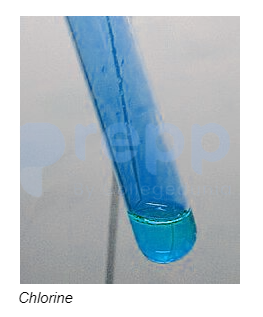
Chlorine
Chlorine gas is used in the preparation of bleaching powder by reacting calcium hydroxide with chlorine gas. The basic reaction is
\(2Ca(OH)_2 + 2Cl_2 Ca(OCl)_2 + CaCl_2 + 2H_2O.\)
Bleaching powder is made in the Bachmann's plant.
The entire apparatus is set up to produce bleaching powder and includes a vertical cast-iron tower with a hopper at the top, two inlets near the base (one for chlorine and the other for hot air), and an exit for waste gases near the top.
It has an atomic number of 17. The uses of chlorine are numerous. In addition to being used to disinfect water, it also aids in the sanitation of sewage and industrial waste. Chlorine is a bleaching agent used in the manufacture of paper and fabric.
Chlorine has several chemical and physical characteristics, including:
- Chlorine is a yellow-green gas when kept at room temperature.
- Chlorine has a strong, unpleasant smell which is similar to that of bleach.
- Since chlorine gas, Chlorine will initially settle close to the ground in places with little air movement, as it has a density that is roughly 2.5 times that of air.
- Despite not being flammable, many common substances, such as ether, turpentine, ammonia, natural gas, and hydrogen can cause explosive reactions or produce explosive compounds when combined with chlorine.
- Chlorine is only marginally soluble in water, as it reacts with moisture to produce hydrochloric acid (HCl) and hypochlorous acid (HClO).
- Chlorine is frequently pressurized and cooled to form an amber-colored liquid, for storage and transportation.
Similar Questions
Which of the following has a pH value of 7?
Which of the following is the most acidic?
The cause of a redox reaction is the:
Important Questions from Acids, Bases & Salts
Which of the following statements is correct according to the law of conservation of mass?
Which of the following is formed when carbon dioxide reacts with calcium hydroxide?
Which of the following types of reaction represents formation of slaked lime from calcium oxide and water?
Which of the following has a pH value of 7?
What is used in the preparation of calcium sulphate hemihydrate?



