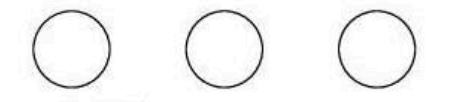
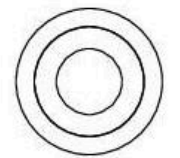
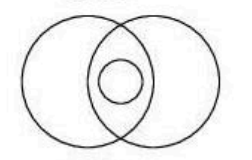
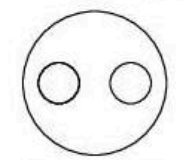
LIST-I
Chromosomal aberrationsLIST-II
Chromosome numberA. Nullisomic I. 2n + 1 B. Monosomic II. 2n + 2 C. Trisomic III. 2n - 2 D. Tetrasomic IV. 2n - 1
Choose the correct answer from the options given below:
Matching Chromosomal Aberrations with Chromosome Number
This question requires matching different types of chromosomal aberrations with their corresponding changes in the diploid chromosome number, typically represented as $2n$. Let's analyze each term from LIST-I:
1. Nullisomic (A)
Definition: Nullisomy refers to the condition where a pair of homologous chromosomes is lost from a diploid set. Chromosome Number: The chromosome number is reduced by two chromosomes, represented as $2n - 2$. Match: This corresponds to option III ($2n - 2$) in LIST-II.
2. Monosomic (B)
Definition: Monosomy is the condition where only one chromosome of a homologous pair is present. Chromosome Number: The chromosome number is reduced by one chromosome, represented as $2n - 1$. Match: This corresponds to option IV ($2n - 1$) in LIST-II.
3. Trisomic (C)
Definition: Trisomy occurs when there is an extra copy of one chromosome in a diploid set. Chromosome Number: The chromosome number is increased by one chromosome, represented as $2n + 1$. Match: This corresponds to option I ($2n + 1$) in LIST-II.
4. Tetrasomic (D)
Definition: Tetrasomy is the condition where a pair of homologous chromosomes is added to a diploid set. Chromosome Number: The chromosome number is increased by two chromosomes, represented as $2n + 2$. Match: This corresponds to option II ($2n + 2$) in LIST-II.
Final Matching Summary
Based on the analysis above, the correct matching is:
- A. Nullisomic - III ($2n - 2$)
- B. Monosomic - IV ($2n - 1$)
- C. Trisomic - I ($2n + 1$)
- D. Tetrasomic - II ($2n + 2$)
Therefore, the correct option is A-III, B-IV, C-I, D-II.
Similar Questions
- Which of the following is not a key feature of Basmati Rice?
- In case of resistance, the rate of reproduction of a plant pathogen will be:
- Backcross breeding method is useful for the improvement of:
- As per Hardy Weinberg Law, in a random mating population what is the frequency of AA genotypes from a cross of Aa (2pq) × Aa (2pq)?
- Given below are two statements: one is labelled as Assertion A and the other is labelled as Reason R
Assertion A: Horizontal resistance is durable as it is non-race specific.
Reason R: Race specific resistance puts pressure on the pathogen to evolve more virulent races.
In the light of the above statements, choose the most appropriate answer from the options given below - Arrange the order of events in the production of the phenotype by a gene.
A. Protein
B. Phenotype
C. Gene
D. RNA
Choose the correct answer from the options given below: - Arrange the different stages of seed production in a sequence.
A. Certified Seed
B. Breeder Seed
C. Nucleus Seed
D. Foundation Seed
Choose the correct answer from the options given below: - Semidwarf wheat and rice were developed by the use of
A. Norin 10 (Rht genes)
B. Taichung Native 1 (TN 1)
C. Norin 10 and Taichung Native 1
D. ppd1
E. ppd2
Choose the correct answer from the options given below: - Characteristic features of mitotic metaphase are ______
A. Each chromosome is unpaired
B. 2n chromosomes are seen
C. Each bivalent has four chromatids
D. Centromeres of all the chromosomes lie on the equatorial plate
E. Homologus chromosomes form bivalents
Choose the correct answer from the options given below: - Match the LIST-I with LIST-II
LIST-I
ScientistLIST-II
DiscoveryA. Yule I. Mitosis B. Watson & Crick II. Multiple factor hypothesis C. Jacob & Monod III. Double helical structure of DNA D. Fleming IV. Operon concept
Choose the correct answer from the options given below:
Important Questions from Miscellaneous
- Which of the following relationships is/are not true?
(A). Most probable velocity = $\sqrt{\frac{2RT}{M}}$
(B). PV = $\frac{3}{2}kT$
(C). Compressibility factor Z = $\frac{pV}{nRT}$
(D). Average kinetic energy of gas = $\frac{1}{2}kT$
Choose the correct answer from the options given below - Match List-I with List-II
List-I List-II Electronic Configuration First Ionisation energy (kJ mol$^{-1}$) (A). ns$^2$ (I). 2100 (B). ns$^2$np$^1$ (II). 1400 (C). ns$^2$np$^3$ (III). 800 (D). ns$^2$np$^6$ (IV). 900
Choose the correct answer from the options given below: - The shielding constant of a 2p electron (calculated using Slater's rules) is
- Match List-I with List-II
List-I List-II Spectroscopy Property (A). Raman (I). Polarizability (B). FTIR (II). Dipole Moment (C). UV-Visible (III). Absorbance (D). NMR (IV). Spin
Choose the correct answer from the options given below: - The structure of protein comprises of:
(A). Primary structure of protein is associated with amino acids
(B). Secondary structure of protein is associated to peptides
(C). Tertiary structure of protein is associated with polypeptide chains
(D). Quaternary structure of protein is associated with polypeptide chains
Choose the correct answer from the options given below: