
Group I Group II P. Martempering 1. Coarse Pearlite Q. Normalising 2. Fine Pearlite R. Subcritical annealing for long time 3. Tempered martensite S. Full annealing 4. Spheroidised cementite in the matrix of ferrite
Matching Heat Treatment Processes to Steel Microstructures
This question requires matching specific heat treatment processes (Group I) with the microstructures they produce in steel (Group II).
Analysis of Heat Treatment Processes
- P. Martempering: This process involves quenching steel to a temperature above the martensite start temperature ($M_s$), holding to equalize temperature, and then cooling to form martensite. The martensite is subsequently tempered. Therefore, the resulting microstructure is Tempered martensite (3).
- Q. Normalising: This process heats steel above the upper critical temperature and cools it in still air. This typically results in a fine-grained microstructure of ferrite and pearlite, specifically Fine Pearlite (2).
- R. Subcritical annealing for long time: Heating steel below the lower critical temperature ($A_1$) for an extended period causes the cementite lamellae within pearlite to break up and form globular shapes. This leads to Spheroidised cementite in the matrix of ferrite (4).
- S. Full annealing: This process involves heating steel into the austenite region, holding, and then slow cooling, usually within the furnace. This controlled slow cooling typically produces a microstructure of ferrite and relatively coarse pearlite, i.e., Coarse Pearlite (1).
Resultant Matches
Based on the analysis:
- P matches with 3 (Tempered martensite)
- Q matches with 2 (Fine Pearlite)
- R matches with 4 (Spheroidised cementite in the matrix of ferrite)
- S matches with 1 (Coarse Pearlite)
Therefore, the correct matching is P-3, Q-2, R-4, S-1.
Important Questions from Heat Treatment Quenching Critical Cooling Rate
- Which of the following statements is/are CORRECT when Ni is added as an alloying element to a low alloy steel?
- In a Jominy end-quench test of the eutectoid plain-carbon steel, which of the following represents the sequence of microstructures observed from the quenched end of the specimen?
- Which one of the following is the correct decreasing sequence of Quenching Power for quenchants used in heat treatment of steels?
- Which one of the following techniques does NOT require quenching to obtain final case hardness?
The microstructures of a quenched steel tempered at three temperatures $T_1 < T_2 < T_3$ for a fixed time are schematically illustrated. The solid circles represent cementite particles in ferrite matrix; $\bar{r}_1, \bar{r}_2$ and $\bar{r}_3$ are average radii of cementite particles, and $V_1, V_2$ and $V_3$ are volume fractions of cementite at temperatures $T_1, T_2$ and $T_3$, respectively.
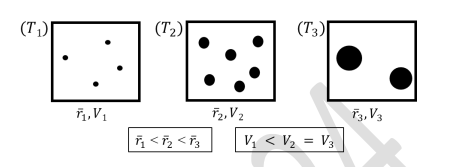
If the cementite in steel is more noble than ferrite, then which one of the three microstructures will have the highest corrosion rate when exposed to an aqueous solution of $3.5 \text{ wt.\% NaCl}$?


