
Question
Match the followingA. Differential weathering or erosion E. Tafoni B. Exfoliation F. Pedestal rock C. Spheroidal weathering G. Corestones D. Cavernous weathering H. Domes
The correct answer is
A – F, B – H, C – G, D – E
Matching Weathering Processes and Features
This question requires matching geological weathering and erosion processes with specific landforms or rock structures they create. Let's break down the correct pairings:
-
A. Differential weathering or erosion is matched with F. Pedestal rock.
- Explanation: Differential weathering causes parts of a rock to erode faster than others. A pedestal rock is formed when the base is eroded more rapidly (e.g., by wind or salt action), creating an undercut and a mushroom-like shape.
-
B. Exfoliation is matched with H. Domes.
- Explanation: Exfoliation involves the shedding of outer layers from a rock mass, often due to pressure release. This process forms large, rounded rock masses or landforms known as exfoliation domes.
-
C. Spheroidal weathering is matched with G. Corestones.
- Explanation: This chemical weathering process rounds rock blocks by attacking joints from all sides. The resulting rounded boulders within a weathered mass are called corestones.
-
D. Cavernous weathering is matched with E. Tafoni.
- Explanation: Cavernous weathering creates small pits or hollows on rock surfaces. Tafoni are specific, often enlarged, examples of these honeycomb-like cavities.
Therefore, the correct matching is A – F, B – H, C – G, D – E.
Was this answer helpful?
Important Questions from Weathering
- Bauxite formation is an example of metal enrichment by extreme
- Silcretes or silica-rich duricrusts generally form under
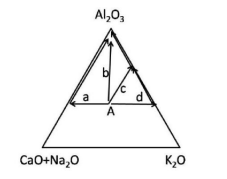
During normal weathering of a granite rock (A), clay minerals and then residue of gibbsite are formed. Which one is the correct weathering path for the rock in the given diagram ($\text{Al}_2\text{O}_3$, $\text{CaO}$, $\text{Na}_2\text{O}$ and $\text{K}_2\text{O}$ are in moles).
- During spheroidal weathering, a block of rock converts to a spheroid due to
- Which type(s) of chemical reactions occur(s) during the weathering of pyroxene?
Need Expert Advice?


