
(a) Phosphofructokinase
(b) Glycogen synthase
(c) $\beta$-galactosidase
(d) Lactate dehydrogenase
1. Product inhibition
2. Control of enzyme synthesis
3. Allosteric interaction
4. Covalent modification
Enzyme Regulatory Mechanisms Matching
This section matches key enzymes with their primary modes of regulation, crucial for understanding metabolic control.
Phosphofructokinase Regulation
Phosphofructokinase (PFK) is a central enzyme in glycolysis.
- Its activity is tightly regulated by allosteric interactions, responding to the cell's energy status (e.g., ATP, AMP levels) and other metabolites.
- Thus, (a) Phosphofructokinase corresponds to mechanism 3.
Glycogen Synthase Regulation
Glycogen synthase plays a vital role in synthesizing glycogen.
- This enzyme's activity is primarily controlled through covalent modification, specifically through phosphorylation and dephosphorylation.
- Hormonal signals modulate these modifications to regulate glycogen storage.
- Therefore, (b) Glycogen synthase corresponds to mechanism 4.
$\beta$-galactosidase Regulation
$\beta$-galactosidase is an enzyme often regulated within operons.
- Its regulation typically involves control of enzyme synthesis, meaning the cell adjusts the rate at which the enzyme is produced based on environmental conditions (e.g., presence of lactose).
- This is achieved through transcriptional control.
- Hence, (c) $\beta$-galactosidase corresponds to mechanism 2.
Lactate Dehydrogenase Regulation
Lactate dehydrogenase (LDH) catalyzes the conversion between pyruvate and lactate.
- A key regulatory feature of LDH is product inhibition, where the accumulation of its product, lactate, can reduce the enzyme's reaction rate.
- Consequently, (d) Lactate dehydrogenase corresponds to mechanism 1.
Final Enzyme-Mechanism Matches
The compiled matches are:
- (a) Phosphofructokinase: 3. Allosteric interaction
- (b) Glycogen synthase: 4. Covalent modification
- (c) $\beta$-galactosidase: 2. Control of enzyme synthesis
- (d) Lactate dehydrogenase: 1. Product inhibition
The resulting sequence representing the matches is -3, -4, -2, -1.
Important Questions from Enzyme Kinetics Michaelis Menten K_m V_{max}
- An enzyme following Michaelis-Menten kinetics, catalyses a reaction with an initial velocity ($V_0$) of $2\ \mu\text{M s}^{-1}$ at the substrate concentration of $10\ \mu\text{M}$. If the turnover number ($k_{\text{cat}}$) of the enzyme for the given substrate is $500\ \text{s}^{-1}$ and the enzyme concentration in the reaction is $0.01\ \mu\text{M}$, then the value of the Michaelis-Menten constant ($K_m$) would be__________ $\times\ 10^{-6}\ \text{M}$ (in integer).
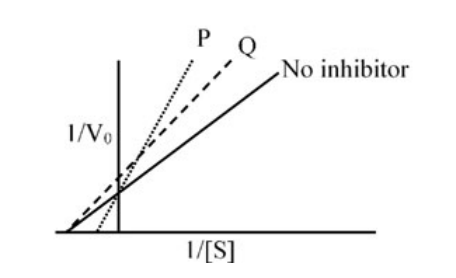
The graph below shows the activity of enzyme pepsin in the presence of inhibitors aliphatic alcohols (P) or N-acetyl-1-phenylalanine (Q). Which ONE of the following represents the nature of inhibition by P and Q, respectively?
The following plot represents the Lineweaver-Burk equation of an enzymatic reaction both in the presence and the absence of inhibitor. Here, V is the velocity of reaction and S is the substrate concentration.
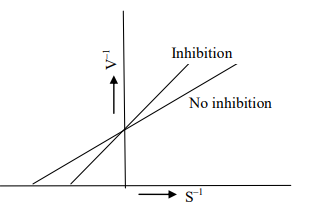
The nature of inhibition shown in the plot is
- For an enzyme catalyzed reaction, the plot that correctly represents the relationship between the rate and temperature is
- In an enzyme catalyzed reaction, the initial reaction velocity is only one fourth of its maximum velocity. If the substrate concentration is $3.0 \times 10^{-3}$ mM, the value of $K_m$ in micro molar ($\mu$M) will be ....


