
Match List-I with List-II: Choose the correct answer from the options given below: List-I List-II (A) Impedance of a series RLC circuit at resonance (I) Voltage across L & C are 180° out of phase (B) For a series LC circuit (II) Current in L & C are 180° out of phase (C) For a parallel LC circuit (III) Minimum (D) Reactance of a capacitor in DC circuit (IV) Infinite
(A)-(III), (B)-(I), (C)-(II), (D)-(IV)
- Impedance of a series RLC circuit at resonance is minimum, so (A) → (III).
- In a series LC circuit, voltage across L & C are 180° out of phase, so (B) → (I).
- For a parallel LC circuit, current in L & C are 180° out of phase, so (C) → (II).
- The reactance of a capacitor in a DC circuit is infinite, so (D) → (IV).
Thus, the correct answer is option 1.
Important Questions from Alternating Current
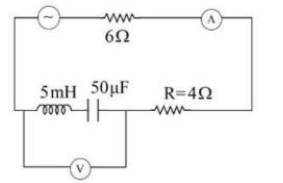
In the shown AC source, the voltage is given as V = 20 cos 2000t. Neglecting source resistance, the voltmeter and ammeter readings will be:
The same current is flowing in two AC circuits. The first circuit contains a pure inductor and the second, a capacitor. If the frequency of the AC is increased, then the current will:
A 25 μF capacitor, a 0.10 H inductor, and a 25 Ω resistor is connected in series with an AC source of emf ε = 310 sin 314t. What is the frequency of the AC source?
The same current is flowing in two AC circuits. The first circuit contains a pure inductor and the second, a capacitor. If the frequency of the AC is increased, then the current will:
A 25 μF capacitor, a 0.10 H inductor, and a 25 Ω resistor is connected in series with an AC source of emf ε = 310 sin 314t. What is the frequency of the AC source?


