
A 25 μF capacitor, a 0.10 H inductor, and a 25 Ω resistor is connected in series with an AC source of emf ε = 310 sin 314t. What is the frequency of the AC source?
50 Hz
Understanding AC Source Frequency from Emf Equation
The question asks for the frequency of the AC source given by the equation \(\varepsilon = 310 \sin 314t\). This equation describes the instantaneous electromotive force (emf) of the source in a series RLC circuit. The standard form for the instantaneous emf of an AC source is:
\(\varepsilon = \varepsilon_0 \sin(\omega t + \phi)\)
Where:
- \(\varepsilon\) is the instantaneous emf
- \(\varepsilon_0\) is the peak emf or voltage
- \(\omega\) is the angular frequency in radians per second (\(\text{rad/s}\))
- \(t\) is time in seconds
- \(\phi\) is the phase angle
Comparing the given equation \(\varepsilon = 310 \sin 314t\) with the standard form, we can identify the key parameters:
- Peak emf, \(\varepsilon_0 = 310 \text{ V}\)
- Angular frequency, \(\omega = 314 \text{ rad/s}\)
- Phase angle, \(\phi = 0\)
We are interested in finding the linear frequency of the AC source, which is denoted by \(f\). The relationship between angular frequency (\(\omega\)) and linear frequency (\(f\)) is given by the formula:
\(\omega = 2 \pi f\)
From this relation, we can find the linear frequency \(f\) by rearranging the formula:
\(f = \frac{\omega}{2 \pi}\)
We have the value of \(\omega\) from the given emf equation, which is \(314 \text{ rad/s}\). We also know that the value of \(\pi\) is approximately \(3.14\).
Now, we can substitute the values into the formula to calculate the frequency \(f\):
\(f = \frac{314}{2 \times 3.14}\)
\(f = \frac{314}{6.28}\)
Performing the calculation:
\(f = 50 \text{ Hz}\)
So, the frequency of the AC source is 50 Hz.
Let's quickly look at the options to confirm our result.
- Option 1: 314 Hz (This is the value of \(\omega\), not \(f\))
- Option 2: 100 Hz (Incorrect calculation)
- Option 3: 50 Hz (Matches our calculated value)
- Option 4: 310 Hz (This is the peak emf \(\varepsilon_0\), not \(f\))
Our calculated frequency of 50 Hz corresponds to Option 3.
Revision Table: Key AC Circuit Concepts
| Concept | Symbol | Relation/Formula | Units |
|---|---|---|---|
| Instantaneous Emf (AC Source) | \(\varepsilon\) | \(\varepsilon = \varepsilon_0 \sin(\omega t + \phi)\) | Volts (V) |
| Peak Emf / Voltage | \(\varepsilon_0\) | Maximum value of \(\varepsilon\) | Volts (V) |
| Angular Frequency | \(\omega\) | \(\omega = 2 \pi f\) | Radians per second (rad/s) |
| Linear Frequency | \(f\) | \(f = \frac{\omega}{2 \pi}\) | Hertz (Hz) |
| Time | \(t\) | Independent variable in emf equation | Seconds (s) |
Additional Information on AC Source Frequency
In alternating current (AC) circuits, the voltage and current vary periodically with time. The frequency of the AC source tells us how many complete cycles of variation occur per second.
Angular Frequency (\(\omega\)): This represents the rate of change of the phase angle of the AC wave. It is measured in radians per second. The term \((\omega t + \phi)\) inside the sine function of the emf equation represents the instantaneous phase angle.
Linear Frequency (\(f\)): This represents the number of complete cycles per second. It is measured in Hertz (Hz). 1 Hz means one cycle per second. The standard power line frequency in many parts of the world is 50 Hz or 60 Hz.
The relationship \(\omega = 2 \pi f\) arises because one complete cycle corresponds to a change in phase of \(2 \pi\) radians. If there are \(f\) cycles per second, the total change in phase per second is \(f \times 2 \pi\), which is the angular frequency \(\omega\).
While the given problem provides information about a capacitor, inductor, and resistor, these components are relevant for calculating impedance, current, or phase angle in the circuit. However, the frequency of the AC source is determined solely by the properties of the source itself, as described by its emf equation \(\varepsilon = \varepsilon_0 \sin(\omega t)\).
Important Questions from Alternating Current
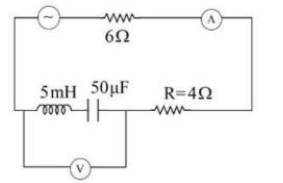
In the shown AC source, the voltage is given as V = 20 cos 2000t. Neglecting source resistance, the voltmeter and ammeter readings will be:
The same current is flowing in two AC circuits. The first circuit contains a pure inductor and the second, a capacitor. If the frequency of the AC is increased, then the current will:
The same current is flowing in two AC circuits. The first circuit contains a pure inductor and the second, a capacitor. If the frequency of the AC is increased, then the current will:
A 25 μF capacitor, a 0.10 H inductor, and a 25 Ω resistor is connected in series with an AC source of emf ε = 310 sin 314t. What is the frequency of the AC source?
Match List-I with List-II:
List-I List-II (A) Impedance of a series RLC circuit at resonance (I) Voltage across L & C are 180° out of phase (B) For a series LC circuit (II) Current in L & C are 180° out of phase (C) For a parallel LC circuit (III) Minimum (D) Reactance of a capacitor in DC circuit (IV) Infinite Choose the correct answer from the options given below:


