Match List - I with List - II.List - I (Compensation) List - II (Characteristics) A. Lead I. Attenuation B. Lag II. Increases bandwidth C. Lag-lead III. Increases damping faster D. Rate IV. Second order
Matching Compensation Types to Characteristics
This question requires matching different types of control system compensation (Lead, Lag, Lag-lead, Rate) with their corresponding characteristics.
Analysis of Compensation Types
- A. Lead Compensation: Primarily aims to improve transient response. It achieves this by adding a pair of complex conjugate poles and a zero, effectively increasing the system's phase margin and bandwidth. This leads to faster response and increased stability margins.
- B. Lag Compensation: Focuses on improving steady-state accuracy. It introduces a pole-zero pair near the origin, with the pole closer to the origin. This increases the system type, reducing steady-state error, but typically reduces the system's bandwidth and may attenuate high-frequency signals.
- C. Lag-Lead Compensation: Combines the advantages of both lag and lead compensators. It uses two poles and two zeros. The lag portion improves steady-state error, while the lead portion improves transient response (damping and speed). The overall dynamic behavior often resembles that of a well-tuned second-order system.
- D. Rate Compensation (Derivative Control): Primarily enhances the damping of the system. By adding a derivative term (proportional to the rate of change of the error signal), it anticipates future error, providing a damping effect that increases stability and reduces overshoot, leading to faster settling time.
Matching Results
- Lead compensation (A) is known for increasing bandwidth (II).
- Lag compensation (B) is associated with attenuation (I) of high frequencies and improving steady-state response.
- Lag-lead compensation (C) often results in characteristics similar to a second-order system (IV) by combining steady-state and transient improvements.
- Rate (Derivative) compensation (D) is effective in increasing damping faster (III).
Therefore, the correct matching is A-II, B-I, C-IV, D-III.
Similar Questions
Match List - I with List - II.
List - I (Laws) List - II (Applications) A. Ampere's law I. Force on a charge B. Biot's law II. Force due to a current carrying conductor C. Coulomb's law III. Electric flux density at a point D. Gauss's law IV. Magnetic flux density at a point - DNS is primarily used for:
The pointing vector $P = E \times H$ represents:
- Arrange these digital logic building blocks in order of increasing complexity:
A. Multiplexers
B. Sequential logic circuits e.g.: counters
C. Combinational logic circuits e.g.: adder
D. ALU (Arithmetic Logic Unit)
Choose the correct answer from the options given below: - Signal flow graph is used to find:
- Consider the following frequency domain specifications required to design a control system:
A. Bandwidth
B. Gain margin
C. Phase margin
D. Maximum overshoot
Choose the correct answer from the options given below: A metal sphere with 1 m radius and a surface charge density of 10 coulombs/$m^2$ is enclosed in a cube of 10 m side. The total outward electric displacement flux normal to the surface of the cube is:
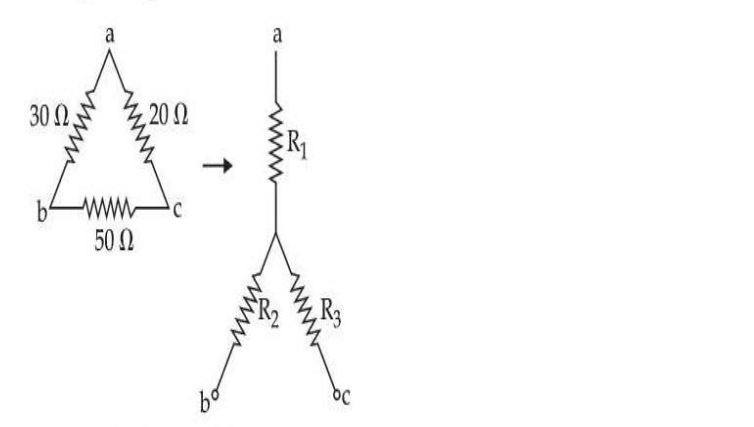
A-network connected with its Y-equivalent is shown in figure. Find the resistance $R_1$, $R_2$ and $R_3$ are respectively:
- Which protocol in the TCP/IP suite is responsible for breaking data into packets and reassembling them at the destination providing reliable, connection-oriented delivery?
Match List - I with List - II.
List - I (Communication System) List - II (Bandwidth) A. AM broadcast I. 7 MHz B. Telephone II. 200 KHz C. Wideband FM III. 4 KHz D. TV IV. 10 KHz
Important Questions from Mixed Topic (CUET PG)
- Who was the founder of Bolshevik Communist party?
- What is the key guide to statecraft in the realist tradition?
- Chronologically arrange the events in the Cold War period.
A. Berlin Wall is constructed
B. Communist China joins the UN
C. Soviet invasion of Czechoslovakia
D. Berlin Blockade
Choose the correct answer from the options given below: Morgenthau's principles of political realism are:
A. Politics is rooted in permanent and unchanging human nature which is basically self centred, self-regarding and self-interested
B. Politics is an autonomous sphere of action and cannot therefore be reduced to morals
C. International Politics is an arena of conflicting self-interests
D. The ethics of international relations is situational ethics which is very different from private morality
Choose the correct answer from the options given below:Who among the following political thinkers consider the anarchical self help system to be a compelling factor for States to maximise their relative power positions?