
The value of 'a' is
Understanding the Probability Density Function (PDF) Property
For any valid probability density function (PDF), $f(x)$, the total probability over its entire domain must equal 1. This means the integral of the PDF function from negative infinity to positive infinity must be 1.
Mathematically, this is expressed as: $ \int_{-\infty}^{\infty} f(x) dx = 1 $
In this problem, we are given the PDF: $ f(x) = ae^{-2|x|} $ where $x$ can be any real number, so the domain is $(-\infty, \infty)$.
Calculating the Constant 'a'
We need to find the value of 'a' that satisfies the property $\int_{-\infty}^{\infty} f(x) dx = 1$.
- Set up the integral equation: $ \int_{-\infty}^{\infty} ae^{-2|x|} dx = 1 $
- Separate the constant 'a': $ a \int_{-\infty}^{\infty} e^{-2|x|} dx = 1 $
-
Handle the absolute value function: The absolute value function $|x|$ is defined differently for negative and positive values of $x$:
- $|x| = -x$ if $x < 0$
- $|x| = x$ if $x \ge 0$
-
Evaluate the integrals:
- First integral: $ \int_{0}^{\infty} e^{-2x} dx = \lim_{b \to \infty} \int_{0}^{b} e^{-2x} dx $ $ = \lim_{b \to \infty} \left[ \frac{e^{-2x}}{-2} \right]_{0}^{b} $ $ = \lim_{b \to \infty} \left( \frac{e^{-2b}}{-2} - \frac{e^{0}}{-2} \right) $ $ = \lim_{b \to \infty} \left( -\frac{1}{2e^{2b}} - \frac{1}{-2} \right) $ As $b \to \infty$, $e^{2b} \to \infty$, so $\frac{1}{2e^{2b}} \to 0$. $ = 0 - \left(-\frac{1}{2}\right) = \frac{1}{2} $
- Second integral: $ \int_{-\infty}^{0} e^{2x} dx = \lim_{c \to -\infty} \int_{c}^{0} e^{2x} dx $ $ = \lim_{c \to -\infty} \left[ \frac{e^{2x}}{2} \right]_{c}^{0} $ $ = \lim_{c \to -\infty} \left( \frac{e^{0}}{2} - \frac{e^{2c}}{2} \right) $ $ = \frac{1}{2} - \lim_{c \to -\infty} \frac{e^{2c}}{2} $ As $c \to -\infty$, $2c \to -\infty$, so $e^{2c} \to 0$. $ = \frac{1}{2} - 0 = \frac{1}{2} $
- Combine the results and solve for 'a': $ a \left( \frac{1}{2} + \frac{1}{2} \right) = 1 $ $ a (1) = 1 $ $ a = 1 $
Conclusion
The value of the constant 'a' that makes $f(x) = ae^{-2|x|}$ a valid probability density function is 1.
Important Questions from Probability (Notes)
- A stick of length L is broken into two pieces at random. What is the average length of the smaller piece?
- Two students are solving the same problem independently. If the probability that the first one solves the problem is $\frac{3}{5}$ and the probability that the second solves the problem is $\frac{4}{5}$, what is the probability that at least one of them solves the problem?
- A fair die was thrown three times and the outcome was repeatedly six. If the die is thrown again what is the probability of getting six?
- 12 balls, 3 each of the colours red, green, blue and yellow are put in a box and mixed. If 3 balls are picked at random, without replacement, the probability that all 3 balls are of the same colour is
A canal system is shown in the figure.
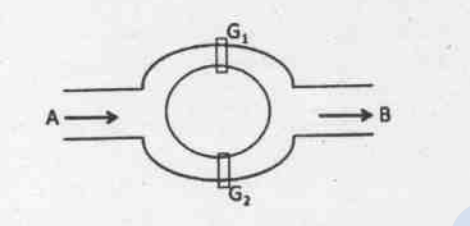
Water flows from A to B through two channels. Gates $G_1$ and $G_2$ are operated independently to regulate the flow. Probability of $G_1$ to be open is 10% while that of $G_2$ is 20%. The probability that water will flow from A to B is


