
Let $S$ be the portion of the plane $z = 2x + 2y - 100$ which lies inside the cylinder $x^2 + y^2 = 1$. If the surface area of $S$ is $\alpha\pi$, then the value of $\alpha$ is equal to ________.
We are asked to find the surface area of the portion of the plane $z = 2x + 2y - 100$ that lies inside the cylinder $x^2 + y^2 = 1$. The surface area is given as $\alpha\pi$, and we need to find the value of $\alpha$.
Calculating Surface Area
The surface area formula for a surface defined by $z = f(x, y)$ over a region $D$ in the xy-plane is:
$ \text{Surface Area} = \iint_D \sqrt{1 + \left(\frac{\partial z}{\partial x}\right)^2 + \left(\frac{\partial z}{\partial y}\right)^2} \,dA $
Partial Derivatives
First, calculate the partial derivatives of $z$ with respect to $x$ and $y$:
- $ \frac{\partial z}{\partial x} = \frac{\partial}{\partial x}(2x + 2y - 100) = 2 $
- $ \frac{\partial z}{\partial y} = \frac{\partial}{\partial y}(2x + 2y - 100) = 2 $
Surface Area Element
Now, substitute these derivatives into the surface area formula's integrand:
$ \sqrt{1 + \left(\frac{\partial z}{\partial x}\right)^2 + \left(\frac{\partial z}{\partial y}\right)^2} = \sqrt{1 + (2)^2 + (2)^2} = \sqrt{1 + 4 + 4} = \sqrt{9} = 3 $
The integrand is a constant value, 3.
Defining the Region D
The region $D$ is the projection onto the xy-plane of the surface $S$. Since the surface lies inside the cylinder $x^2 + y^2 = 1$, the region $D$ is the disk defined by $x^2 + y^2 \leq 1$. This is a circle with radius $r=1$.
Evaluating the Integral
The surface area integral becomes:
$ \text{Surface Area} = \iint_D 3 \,dA $
Since 3 is a constant, we can pull it out of the integral:
$ \text{Surface Area} = 3 \iint_D \,dA $
The integral $\iint_D \,dA$ represents the area of the region $D$. The area of the disk $D$ (with radius 1) is $ \pi r^2 = \pi (1)^2 = \pi $.
Therefore, the surface area is:
$ \text{Surface Area} = 3 \times \pi = 3\pi $
Determining Alpha
We are given that the surface area is $ \alpha\pi $. By comparing this with our calculated surface area:
$ \alpha\pi = 3\pi $
Dividing both sides by $\pi$, we find:
$ \alpha = 3 $
The value of $\alpha$ is 3.
Important Questions from Mensuration and Geometry
In the given figure, PQRS is a square of side 2 cm and PLMN is a rectangle. The corner L of the rectangle is on the side QR. Side MN of the rectangle passes through the corner S of the square.
What is the area (in cm²) of the rectangle PLMN?
Note: The figure shown is representative.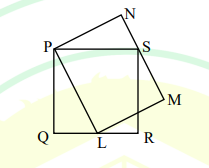
A regular dodecagon (12-sided regular polygon) is inscribed in a circle of radius $r$ cm as shown in the figure. The side of the dodecagon is $d$ cm. All the triangles (numbered 1 to 12) in the figure are used to form squares of side $r$ cm and each numbered triangle is used only once to form a square.
The number of squares that can be formed and the number of triangles required to form each square, respectively, are:
Note: The figure shown is representative.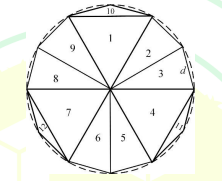
- Which one of the following options has the correct sequence of objects arranged in the increasing number of mirror lines (lines of symmetry)?
- A circle with center at $(x, y) = (0.5, 0)$ and radius $= 0.5$ intersects with another circle with center at $(x, y) = (1, 1)$ and radius $= 1$ at two points. One of the points of intersection $(x, y)$ is:
- During a half-moon phase, the Earth-Moon-Sun form a right triangle. If the Moon-Earth-Sun angle at this half-moon phase is measured to be $89.85^{\circ}$, the ratio of the Earth-Sun and Earth-Moon distances is closest to


