
The problem asks for the ratio of the distance from the Earth to the Sun (ES) to the distance from the Earth to the Moon (EM) during a half-moon phase, given a specific angle measurement.
Geometric Setup
We can model the positions of the Sun (S), Earth (E), and Moon (M) as forming a triangle, $\triangle EMS$.
- The problem states it's a half-moon phase, which implies the angle subtended by the Moon at the Earth, $\angle MES$, is approximately $90^{\circ}$.
- The problem specifies that the "Moon-Earth-Sun angle" is measured to be $89.85^{\circ}$. This corresponds to the angle at the Moon, $\angle EMS = 89.85^{\circ}$.
- We need to find the ratio $\frac{ES}{EM}$.
Calculating the Angle at the Moon
The sum of angles in a triangle is $180^{\circ}$. Using the angles identified:
$ \angle MES + \angle ESM + \angle EMS = 180^{\circ} $
Substituting the known values:
$ 90^{\circ} + \angle ESM + 89.85^{\circ} = 180^{\circ} $
Solving for $\angle ESM$ (the angle subtended by the Earth at the Moon):
$ \angle ESM = 180^{\circ} - 90^{\circ} - 89.85^{\circ} $
$ \angle ESM = 0.15^{\circ} $
Applying the Law of Sines
The Law of Sines relates the sides of a triangle to the sines of its opposite angles:
$ \frac{EM}{\sin(\angle ESM)} = \frac{ES}{\sin(\angle EMS)} $
Rearranging the formula to find the desired ratio $\frac{ES}{EM}$:
$ \frac{ES}{EM} = \frac{\sin(\angle EMS)}{\sin(\angle ESM)} $
Calculating the Distance Ratio
Substitute the angle values into the equation:
$ \frac{ES}{EM} = \frac{\sin(89.85^{\circ})}{\sin(0.15^{\circ})} $
Using trigonometric values:
- $ \sin(89.85^{\circ}) = \sin(90^{\circ} - 0.15^{\circ}) = \cos(0.15^{\circ}) \approx 0.9999966 $
- $ \sin(0.15^{\circ}) \approx 0.0026177 $
Now, calculate the ratio:
$ \frac{ES}{EM} \approx \frac{0.9999966}{0.0026177} \approx 381.975 $
Conclusion
The calculated ratio of the Earth-Sun distance to the Earth-Moon distance is approximately 381.975. This value is closest to 382.
Important Questions from Mensuration and Geometry
In the given figure, PQRS is a square of side 2 cm and PLMN is a rectangle. The corner L of the rectangle is on the side QR. Side MN of the rectangle passes through the corner S of the square.
What is the area (in cm²) of the rectangle PLMN?
Note: The figure shown is representative.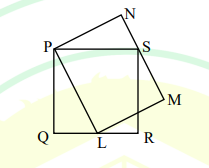
A regular dodecagon (12-sided regular polygon) is inscribed in a circle of radius $r$ cm as shown in the figure. The side of the dodecagon is $d$ cm. All the triangles (numbered 1 to 12) in the figure are used to form squares of side $r$ cm and each numbered triangle is used only once to form a square.
The number of squares that can be formed and the number of triangles required to form each square, respectively, are:
Note: The figure shown is representative.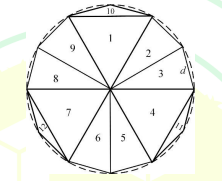
- Which one of the following options has the correct sequence of objects arranged in the increasing number of mirror lines (lines of symmetry)?
- A circle with center at $(x, y) = (0.5, 0)$ and radius $= 0.5$ intersects with another circle with center at $(x, y) = (1, 1)$ and radius $= 1$ at two points. One of the points of intersection $(x, y)$ is:
Let $S$ be the portion of the plane $z = 2x + 2y - 100$ which lies inside the cylinder $x^2 + y^2 = 1$. If the surface area of $S$ is $\alpha\pi$, then the value of $\alpha$ is equal to ________.


