
In the given figure, PQRS is a square of side 2 cm and PLMN is a rectangle. The corner L of the rectangle is on the side QR. Side MN of the rectangle passes through the corner S of the square.
What is the area (in cm²) of the rectangle PLMN?
Note: The figure shown is representative.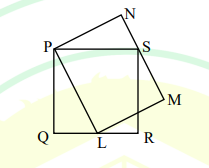
To determine the area of rectangle PLMN, we will use the given information that PQRS is a square with a side length of 2 cm, and PLMN is a rectangle with a corner on side QR and side MN passing through corner S.
- First, note that side QR of square PQRS is 2 cm because it is one side of the square.
- The corner L of rectangle PLMN lies somewhere on QR, meaning L divides QR into two segments: QL and LR. Let QL = x, then LR = 2 - x.
- Since side MN passes through S, and since sides MN and PL are both parallel to sides of the square, PL and MN must be equal in length to the sides of the square PQ and SR, respectively.
- Assume PL is parallel to PQ. Thus, the length of PL (and therefore MN) equals the height of the square, which is 2 cm.
- The rectangle's width, on the other hand, will be the length LR which equals \(2 - x\) cm.
- However, for the rectangle to pass through S while maintaining the shape constraint, x has to be such that PL + LR forms a complete side of the square.
Summary and Calculation:
- The width of the rectangle is calculated as MS, which is 2 cm because MN includes the whole side SR, and hence it extends from M to S.
- The height of the rectangle (PL) is also 2 cm because it remains parallel to the top of the square.
Finally, the area of the rectangle PLMN is given by the formula:
\(\text{Area of Rectangle} = \text{Length} \times \text{Width} = 2 \, \text{cm} \times 2 \, \text{cm} = 4 \, \text{cm}^2\)
Thus, the correct option is 4 cm².
Important Questions from Mensuration and Geometry
A regular dodecagon (12-sided regular polygon) is inscribed in a circle of radius $r$ cm as shown in the figure. The side of the dodecagon is $d$ cm. All the triangles (numbered 1 to 12) in the figure are used to form squares of side $r$ cm and each numbered triangle is used only once to form a square.
The number of squares that can be formed and the number of triangles required to form each square, respectively, are:
Note: The figure shown is representative.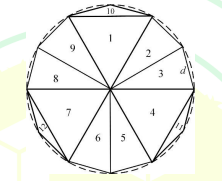
- Which one of the following options has the correct sequence of objects arranged in the increasing number of mirror lines (lines of symmetry)?
- A circle with center at $(x, y) = (0.5, 0)$ and radius $= 0.5$ intersects with another circle with center at $(x, y) = (1, 1)$ and radius $= 1$ at two points. One of the points of intersection $(x, y)$ is:
- During a half-moon phase, the Earth-Moon-Sun form a right triangle. If the Moon-Earth-Sun angle at this half-moon phase is measured to be $89.85^{\circ}$, the ratio of the Earth-Sun and Earth-Moon distances is closest to
Let $S$ be the portion of the plane $z = 2x + 2y - 100$ which lies inside the cylinder $x^2 + y^2 = 1$. If the surface area of $S$ is $\alpha\pi$, then the value of $\alpha$ is equal to ________.


