
Finding the Locus of Intersection Point P
Given points: $A (0, a + 2)$, $B (0, a)$, $C (-2, 0)$ and $D (2, 0)$.
Line AD: Passes through $A(0, a+2)$ and $D(2, 0)$.
- Slope $m_{AD} = \frac{0 - (a+2)}{2 - 0} = -\frac{a+2}{2}$.
- Equation (using point-slope form with D): $y - 0 = -\frac{a+2}{2} (x - 2)$.
- $y = -\frac{a+2}{2}x + (a+2)$. (1)
Line BC: Passes through $B(0, a)$ and $C(-2, 0)$.
- Slope $m_{BC} = \frac{0 - a}{-2 - 0} = \frac{a}{2}$.
- Equation (using point-slope form with B): $y - a = \frac{a}{2} (x - 0)$.
- $y = \frac{a}{2}x + a$. (2)
Intersection Point P(x, y): Set equations (1) and (2) equal.
- $-\frac{a+2}{2}x + (a+2) = \frac{a}{2}x + a$.
- Multiply by 2: $-(a+2)x + 2(a+2) = ax + 2a$.
- $-ax - 2x + 2a + 4 = ax + 2a$.
- $-2x + 4 = 2ax$.
- $4 = 2ax + 2x = 2x(a+1)$.
- $x = \frac{4}{2(a+1)} = \frac{2}{a+1}$.
- Substitute x into (2): $y = \frac{a}{2} \left(\frac{2}{a+1}\right) + a = \frac{a}{a+1} + a = \frac{a + a(a+1)}{a+1} = \frac{a^2 + 2a}{a+1}$.
Locus Equation: Eliminate 'a'.
- From $x = \frac{2}{a+1}$, we have $a+1 = \frac{2}{x} \implies a = \frac{2}{x} - 1 = \frac{2-x}{x}$.
- Substitute 'a' into the expression for y: $y = \frac{a(a+2)}{a+1} = \frac{(\frac{2-x}{x})(\frac{2-x}{x} + 2)}{\frac{2}{x}}$.
- $y = \frac{(\frac{2-x}{x})(\frac{2-x+2x}{x})}{2/x} = \frac{(\frac{2-x}{x})(\frac{2+x}{x})}{2/x} = \frac{(4-x^2)/x^2}{2/x}$.
- $y = \frac{4-x^2}{x^2} \cdot \frac{x}{2} = \frac{4-x^2}{2x}$.
- $2xy = 4 - x^2$.
- The locus is $f(x, y) = x^2 + 2xy - 4 = 0$.
Finding Tangent Parameters
The tangent to the curve $x^2 + 2xy - 4 = 0$ at a point $(x_0, y_0)$ is given by $x x_0 + (x y_0 + y x_0) - 4 = 0$.
The point is $(4, \gamma)$. Substitute $x_0 = 4, y_0 = \gamma$.
- First, find $\gamma$ using the locus equation: $4^2 + 2(4)(\gamma) - 4 = 0$.
- $16 + 8\gamma - 4 = 0 \implies 12 + 8\gamma = 0 \implies \gamma = -\frac{12}{8} = -\frac{3}{2}$.
Tangent Equation: Substitute $(4, -3/2)$ into the tangent formula.
- $x(4) + (x(-\frac{3}{2}) + y(4)) - 4 = 0$.
- $4x - \frac{3}{2}x + 4y - 4 = 0$.
- $\frac{5}{2}x + 4y = 4$.
Comparing with $\frac{x}{\alpha} + \frac{y}{\beta} = 1$:
- Divide the tangent equation by 4: $\frac{5}{8}x + y = 1$.
- Comparing coefficients: $\frac{1}{\alpha} = \frac{5}{8} \implies \alpha = \frac{8}{5}$.
- $\frac{1}{\beta} = 1 \implies \beta = 1$.
Calculating the Final Value
Find parameter 'a':
- Use the x-coordinate of P: $x = \frac{2}{a+1}$.
- We know $x=4$ for the point $(4, \gamma)$.
- $4 = \frac{2}{a+1} \implies a+1 = \frac{2}{4} = \frac{1}{2}$.
- $a = \frac{1}{2} - 1 = -\frac{1}{2}$.
Calculate $a(\beta - \gamma)$:
- We have $a = -\frac{1}{2}$, $\beta = 1$, and $\gamma = -\frac{3}{2}$.
- $a(\beta - \gamma) = \left(-\frac{1}{2}\right) \left(1 - \left(-\frac{3}{2}\right)\right)$.
- $= \left(-\frac{1}{2}\right) \left(1 + \frac{3}{2}\right) = \left(-\frac{1}{2}\right) \left(\frac{5}{2}\right)$.
- $= -\frac{5}{4}$.
Similar Questions
- If $\int_0^1 4 \cot^{-1}(1 - 2x + 4x^2) dx = a \tan^{-1}(2) - b \log_e(5)$, where $a, b \in \mathbf{N}$, then $(2a + b)$ is equal to __________.
- The number of elements in the set $S = \left\{ x : x \in [0, 100] \text{ and } \int_{0}^{x} t^2 \sin(x-t)dt = x^2 \right\}$ is _____
- Let $y = y(x)$ be the solution of the differential equation $x \sin\left(\frac{y}{x}\right) dy = \left(y \sin\left(\frac{y}{x}\right) - x\right) dx$, $y(1) = \frac{\pi}{2}$ and let $\alpha = \cos\left(\frac{y(e^{12})}{e^{12}}\right)$. Then the number of integral value of $p$, for which the equation $x^2 + y^2 - 2px + 2py + \alpha + 2 = 0$ represents a circle of radius $r \leq 6$, is _________.
- If the area of the region bounded by $16x^2 - 9y^2 = 144$ and $8x - 3y = 24$ is $A$, then $3(A + 6\log_e(3))$ is equal to __________.
- The number of points, at which the function $f(x) = \max\{6x, 2 + 3x^2\} + |x - 1| \cos|x^2 - \frac{1}{4}|, x \in (-\pi, \pi)$, is not differentiable, is _____.
Let $f(x) = \begin{cases} e^{x-1} & , x < 0 \\ x^2 - 5x + 6 & , x \geq 0 \end{cases}$ and $g(x) = f(|x|) + |f(x)|$. If the number of points where $g$ is not continuous and is not differentiable are $\alpha$ and $\beta$ respectively, then $\alpha + \beta$ is equal to ________
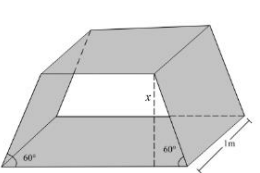
An air duct is made of a thick metallic sheet. The duct is open from front and back. Its cross-section is a trapezium of base angles $60^\circ$ and area $1.5$ m$^2$. Its length is $1$ m. (see the figure). If its height $x = x_0$ (in metres) so that the area of the metallic sheet used for its construction is minimum, then $16 (x_0)^4$ is equal to ________
- If the area enclosed by the curves $y = x^2$, $y^3 = x$, $x = -1$ and $y = x^2$, $y^3 = x$, $x = 1$, above the line $x = 2y$ is $\frac{n}{n+1}$, then $n$ is equal to ________
- The curve satisfying the differential equation, $(x^2-y^2)dx + 2xydy = 0$ and passing through the point (1,1) is :-
The area of the region bounded by the curve $y = \max \{|x|, x|x-2|\}$, the x-axis and the lines $x = -2$ and $x = 4$ is equal to
Important Questions from Calculus
- If $\int_0^1 4 \cot^{-1}(1 - 2x + 4x^2) dx = a \tan^{-1}(2) - b \log_e(5)$, where $a, b \in \mathbf{N}$, then $(2a + b)$ is equal to __________.
- The number of elements in the set $S = \left\{ x : x \in [0, 100] \text{ and } \int_{0}^{x} t^2 \sin(x-t)dt = x^2 \right\}$ is _____
- Let $y = y(x)$ be the solution of the differential equation $x \sin\left(\frac{y}{x}\right) dy = \left(y \sin\left(\frac{y}{x}\right) - x\right) dx$, $y(1) = \frac{\pi}{2}$ and let $\alpha = \cos\left(\frac{y(e^{12})}{e^{12}}\right)$. Then the number of integral value of $p$, for which the equation $x^2 + y^2 - 2px + 2py + \alpha + 2 = 0$ represents a circle of radius $r \leq 6$, is _________.
- If the area of the region bounded by $16x^2 - 9y^2 = 144$ and $8x - 3y = 24$ is $A$, then $3(A + 6\log_e(3))$ is equal to __________.
- The number of points, at which the function $f(x) = \max\{6x, 2 + 3x^2\} + |x - 1| \cos|x^2 - \frac{1}{4}|, x \in (-\pi, \pi)$, is not differentiable, is _____.


