
An air duct is made of a thick metallic sheet. The duct is open from front and back. Its cross-section is a trapezium of base angles $60^\circ$ and area $1.5$ m$^2$. Its length is $1$ m. (see the figure). If its height $x = x_0$ (in metres) so that the area of the metallic sheet used for its construction is minimum, then $16 (x_0)^4$ is equal to ________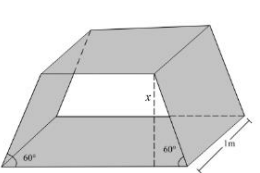
1. Identify the geometry of the trapezium cross-section:
Let the top parallel side be $b$ and the bottom parallel side be $a$. The base angles are $60^\circ$ and the height is $x$.
- The slant height (non-parallel side) $s = \frac{x}{\sin 60^\circ} = \frac{x}{\sqrt{3}/2} = \frac{2x}{\sqrt{3}}$.
- The horizontal extension on each side of the bottom base relative to the top base is $x \cot 60^\circ = \frac{x}{\sqrt{3}}$.
- Therefore, the bottom base $a = b + 2\left(\frac{x}{\sqrt{3}}\right) = b + \frac{2x}{\sqrt{3}}$.
2. Use the cross-sectional area constraint:
The area of the trapezium is given as $1.5\text{ m}^2$:
$\text{Area} = \frac{a + b}{2} \cdot x = \frac{(b + \frac{2x}{\sqrt{3}}) + b}{2} \cdot x = \left(b + \frac{x}{\sqrt{3}}\right)x$
$1.5 = bx + \frac{x^2}{\sqrt{3}} \implies b = \frac{1.5}{x} - \frac{x}{\sqrt{3}}$
3. Define the surface area of the metallic sheet:
Since the length $L = 1\text{ m}$ and the duct is open at both ends, the area $S$ of the sheet used is the product of the cross-section's perimeter ($P$) and the length:
$S = P \cdot L = (a + b + 2s) \cdot 1$
$S = \left(b + \frac{2x}{\sqrt{3}}\right) + b + 2\left(\frac{2x}{\sqrt{3}}\right) = 2b + \frac{6x}{\sqrt{3}} = 2b + 2x\sqrt{3}$
Substitute the expression for $b$:
$S = 2\left(\frac{1.5}{x} - \frac{x}{\sqrt{3}}\right) + 2x\sqrt{3} = \frac{3}{x} - \frac{2x}{\sqrt{3}} + 2x\sqrt{3}$
$S = \frac{3}{x} + \frac{4x}{\sqrt{3}}$
4. Minimize the area (optimization):
Differentiate $S$ with respect to $x$ and set it to zero for a minimum at $x = x_0$:
$\frac{dS}{dx} = -\frac{3}{x^2} + \frac{4}{\sqrt{3}} = 0$
$\frac{3}{x_0^2} = \frac{4}{\sqrt{3}} \implies x_0^2 = \frac{3\sqrt{3}}{4}$
5. Calculate the final value:
$(x_0)^4 = (x_0^2)^2 = \left(\frac{3\sqrt{3}}{4}\right)^2 = \frac{9 \cdot 3}{16} = \frac{27}{16}$
$16(x_0)^4 = 16 \cdot \frac{27}{16} = 27$
The value of 16(x0)4 is 27.
Similar Questions
- If $\int_0^1 4 \cot^{-1}(1 - 2x + 4x^2) dx = a \tan^{-1}(2) - b \log_e(5)$, where $a, b \in \mathbf{N}$, then $(2a + b)$ is equal to __________.
- The number of elements in the set $S = \left\{ x : x \in [0, 100] \text{ and } \int_{0}^{x} t^2 \sin(x-t)dt = x^2 \right\}$ is _____
- Let $y = y(x)$ be the solution of the differential equation $x \sin\left(\frac{y}{x}\right) dy = \left(y \sin\left(\frac{y}{x}\right) - x\right) dx$, $y(1) = \frac{\pi}{2}$ and let $\alpha = \cos\left(\frac{y(e^{12})}{e^{12}}\right)$. Then the number of integral value of $p$, for which the equation $x^2 + y^2 - 2px + 2py + \alpha + 2 = 0$ represents a circle of radius $r \leq 6$, is _________.
- If the area of the region bounded by $16x^2 - 9y^2 = 144$ and $8x - 3y = 24$ is $A$, then $3(A + 6\log_e(3))$ is equal to __________.
- The number of points, at which the function $f(x) = \max\{6x, 2 + 3x^2\} + |x - 1| \cos|x^2 - \frac{1}{4}|, x \in (-\pi, \pi)$, is not differentiable, is _____.
Let $f(x) = \begin{cases} e^{x-1} & , x < 0 \\ x^2 - 5x + 6 & , x \geq 0 \end{cases}$ and $g(x) = f(|x|) + |f(x)|$. If the number of points where $g$ is not continuous and is not differentiable are $\alpha$ and $\beta$ respectively, then $\alpha + \beta$ is equal to ________
- If the area enclosed by the curves $y = x^2$, $y^3 = x$, $x = -1$ and $y = x^2$, $y^3 = x$, $x = 1$, above the line $x = 2y$ is $\frac{n}{n+1}$, then $n$ is equal to ________
- Let $A (0, a + 2)$, $B (0, a)$, $C (-2, 0)$ and $D (2, 0)$ be four points and the lines $AD$ and $BC$ intersect at $P (x, y)$. If the locus of $P$ is the curve $f (x, y) = 0$ and the tangent at the point $(4, \gamma)$ on this curve is $\frac{x}{\alpha} + \frac{y}{\beta} = 1$, then $a (\beta - \gamma)$ is equal to ________
- The curve satisfying the differential equation, $(x^2-y^2)dx + 2xydy = 0$ and passing through the point (1,1) is :-
The area of the region bounded by the curve $y = \max \{|x|, x|x-2|\}$, the x-axis and the lines $x = -2$ and $x = 4$ is equal to
Important Questions from Calculus
- If $\int_0^1 4 \cot^{-1}(1 - 2x + 4x^2) dx = a \tan^{-1}(2) - b \log_e(5)$, where $a, b \in \mathbf{N}$, then $(2a + b)$ is equal to __________.
- The number of elements in the set $S = \left\{ x : x \in [0, 100] \text{ and } \int_{0}^{x} t^2 \sin(x-t)dt = x^2 \right\}$ is _____
- Let $y = y(x)$ be the solution of the differential equation $x \sin\left(\frac{y}{x}\right) dy = \left(y \sin\left(\frac{y}{x}\right) - x\right) dx$, $y(1) = \frac{\pi}{2}$ and let $\alpha = \cos\left(\frac{y(e^{12})}{e^{12}}\right)$. Then the number of integral value of $p$, for which the equation $x^2 + y^2 - 2px + 2py + \alpha + 2 = 0$ represents a circle of radius $r \leq 6$, is _________.
- If the area of the region bounded by $16x^2 - 9y^2 = 144$ and $8x - 3y = 24$ is $A$, then $3(A + 6\log_e(3))$ is equal to __________.
- The number of points, at which the function $f(x) = \max\{6x, 2 + 3x^2\} + |x - 1| \cos|x^2 - \frac{1}{4}|, x \in (-\pi, \pi)$, is not differentiable, is _____.


