
Laterite Mineralogy and Geographical Zones
Laterite soils are known for forming under conditions of intense weathering and leaching, typically found in hot and humid climates.
Understanding Laterite Mineral Composition
- The question highlights the predominance of gibbsite ($Al(OH)_3$) and goethite ($FeO(OH)$) over bohemite ($AlO(OH)$) and hematite ($Fe_2O_3$).
- Gibbsite and goethite are stable end-products of intense chemical weathering and leaching processes.
- This specific mineralogy indicates that the parent material has undergone significant removal of silica and bases, leaving behind residual aluminum and iron hydroxides/oxides.
Relating Minerals to Geographical Zones
The conditions required for the formation of laterites with this mineral dominance are:
- High Temperatures: Accelerate chemical reactions.
- High Rainfall & Leaching: Essential for removing soluble components and promoting the formation of stable hydroxides/oxides.
Let's analyze the options:
- Equatorial Zone: Characterized by consistently high temperatures and heavy rainfall throughout the year. These conditions promote the most intense and prolonged chemical weathering and leaching, favouring the formation of highly weathered minerals like gibbsite and goethite.
- Tropical Zone: Also hot and humid, often with distinct wet and dry seasons. Laterization occurs here, but the equatorial zone typically experiences more extreme and consistent weathering conditions.
- Temperate Zone: Moderate temperatures and rainfall lead to less intense weathering and different soil types.
- Polar Zone: Very low temperatures and limited moisture result in minimal chemical weathering.
Therefore, the predominance of gibbsite and goethite points towards the most intense weathering environment.
Conclusion on Geographical Location
The exceptionally high degree of weathering and leaching required for gibbsite and goethite to dominate over other aluminum and iron minerals is most characteristic of the consistently hot and wet equatorial climate.
Important Questions from Weathering
- Bauxite formation is an example of metal enrichment by extreme
- Silcretes or silica-rich duricrusts generally form under
During normal weathering of a granite rock (A), clay minerals and then residue of gibbsite are formed. Which one is the correct weathering path for the rock in the given diagram ($\text{Al}_2\text{O}_3$, $\text{CaO}$, $\text{Na}_2\text{O}$ and $\text{K}_2\text{O}$ are in moles).
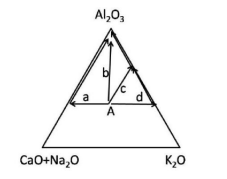
- During spheroidal weathering, a block of rock converts to a spheroid due to
- Which type(s) of chemical reactions occur(s) during the weathering of pyroxene?


