
In the mid-latitudes, temperature increases with height above 20 km, reaching a maximum of 270 K near 50 km, decreasing to a second minimum of 180K near 85 km. Identify the correct statement:
Lapse rate in the mesosphere is smaller than that in the troposphere
Lapse Rate Definition and Atmospheric Layers
The lapse rate refers to the rate at which atmospheric temperature changes with an increase in altitude.
- Troposphere: Temperature typically decreases with height. This is a positive lapse rate, averaging about 6.5 K/km.
- Stratosphere: Temperature generally increases with height due to ozone absorption of ultraviolet radiation. This is a negative lapse rate (temperature inversion).
- Mesosphere: Temperature decreases with height, similar to the troposphere, exhibiting a positive lapse rate.
Mesosphere Temperature Profile and Lapse Rate Calculation
The question provides the temperature profile for the mesosphere in mid-latitudes:
- At 50 km altitude, the temperature is 270 K.
- At 85 km altitude, the temperature is 180 K.
To calculate the lapse rate in the mesosphere:
- Calculate the change in altitude:
$\Delta z = 85 \text{ km} - 50 \text{ km} = 35 \text{ km}$
- Calculate the change in temperature:
$\Delta T = 270 \text{ K} - 180 \text{ K} = 90 \text{ K}$
- Calculate the lapse rate:
Lapse RateMesosphere $= \frac{\Delta T}{\Delta z} = \frac{90 \text{ K}}{35 \text{ km}} \approx 2.57 \text{ K/km}$
Comparing Mesosphere vs. Troposphere Lapse Rates
We need to compare the calculated mesosphere lapse rate with the typical troposphere lapse rate.
- Lapse RateMesosphere $\approx 2.57 \text{ K/km}$ (temperature decreases with height).
- Lapse RateTroposphere $\approx 6.5 \text{ K/km}$ (temperature decreases with height).
Comparing the values:
$2.57 \text{ K/km} < 6.5 \text{ K/km}$
Conclusion: Mesosphere Lapse Rate Smaller
The calculation shows that the lapse rate in the mesosphere (approx. 2.57 K/km) is indeed smaller than the average lapse rate in the troposphere (approx. 6.5 K/km).
Therefore, the statement "Lapse rate in the mesosphere is smaller than that in the troposphere" is correct.
Important Questions from Principles Of Stratigraphy
- Which one of the following molecules is the most buoyant in the atmosphere?
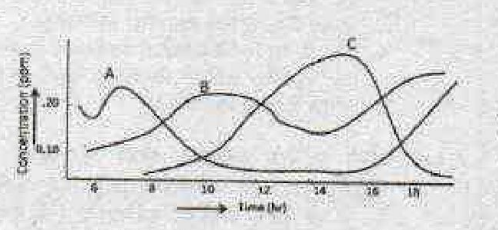
In the above diagram, A, B and C represent, respectively, the tropospheric concentrations of
- Oxygen atom required to form tropospheric ozone comes from
- Atmospheric layers where convection takes place are
Radiocarbon, used for dating sediments, is produced at the top of the Earth's atmosphere by the


