In the hypothetical isobaric ternary liquidus projection diagram given below, solid phases A, B, C, D and E exist in equilibrium with liquid. The reaction taking place at the isobaric invariant point W is
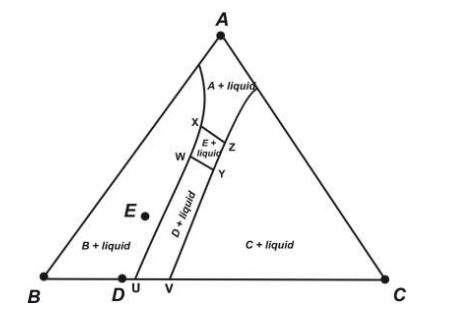
Let's break down the given problem related to the isobaric ternary liquidus projection diagram.
An isobaric ternary liquidus projection diagram helps in understanding the phase relationships at constant pressure. Here, the diagram shows solid phases A, B, C, D, and E in equilibrium with the liquid.
The objective is to determine the correct reaction occurring at the isobaric invariant point W.
Let's analyze the options step-by-step:
- Liquid (at W) = B + D + E: This suggests that at point W, the liquid phase is coexisting with solid phases B, D, and E. However, this scenario is not consistent with the ternary equilibria shown, where reactions typically involve the transformation of phases.
- Liquid (at W) = A + B + D: Similar reasoning applies here; this option suggests coexistence rather than a reaction, which doesn't typically indicate a phase transformation at an invariant point.
- Liquid (at W) + E = B + D: This represents a peritectic reaction where the liquid phase and solid phase E produce solid phases B and D. This is consistent with peritectic reactions found in such diagrams, where the liquid reacts with a solid to form new solid phases.
- Liquid (at W) + B + D = E: This would imply that B and D are reacting with the liquid to produce phase E, which doesn't align with the concept of an invariant reaction in this context.
Therefore, the correct reaction taking place at the isobaric invariant point W is Liquid (at W) + E = B + D, indicating a peritectic reaction. This scenario matches the typical phase transformations depicted in ternary phase diagrams.
Important Questions from Igneous Petrology (Binary and Ternary Phase Diagrams)
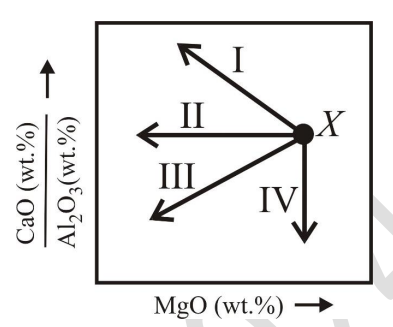
If 'X' represents the initial composition of a melt, which one of the trends indicated by arrows in the schematic diagram corresponds to the evolution of the residual melt composition during crystallization of diopside?
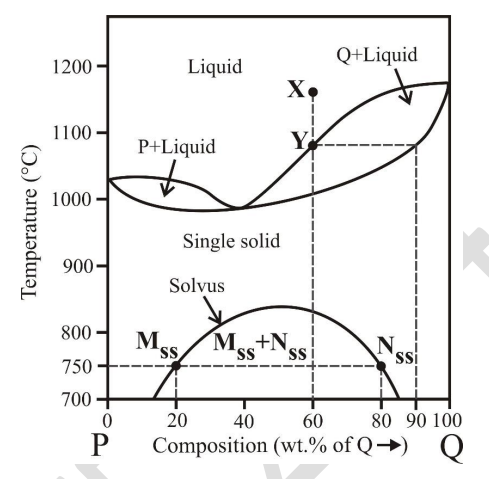
The diagram given below shows phase relations between components P and Q at 1 bar pressure. If ‘X' represents the initial liquid composition, which of the following statements is/are CORRECT during equilibrium crystallization?
- Choose the CORRECT statement regarding crystallization of a single feldspar of composition $Or_{50}Ab_{50}$ in the Albite-Orthoclase system.
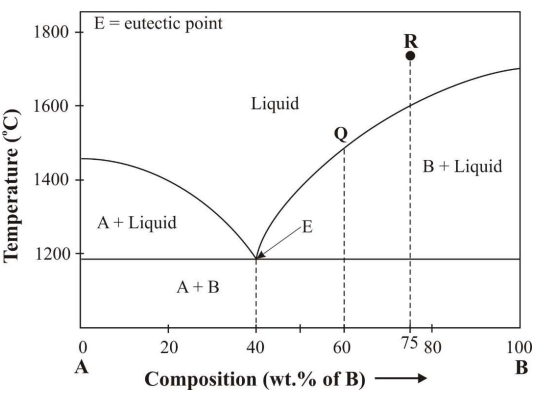
The following diagram shows phase relations in a system consisting of components A and B at 1 bar pressure. If the initial composition of liquid is R, during cooling and crystallization of magma, which of the following statement(s) is/are CORRECT?
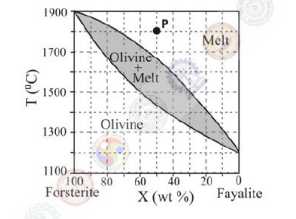
The given T-X diagram shows the phase relations in olivine solid solution at 1 bar pressure. If 'P' is the initial position of melt, the proportion of melt at $1500^\circ$C is __________ %.