
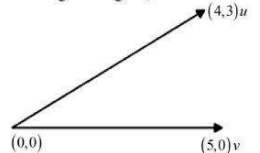
In the given figure, the vectors u and v are related as: Au = v by a transformation matrix A. The correct choice of matrix A is
\( \begin{bmatrix} \frac{4}{5} & \frac{3}{5} \\-\frac{3}{5} & \frac{4}{5} \end{bmatrix}\)
To find the correct transformation matrix \( A \) that relates vectors \( \mathbf{u} \) and \( \mathbf{v} \), we need to express vector \( \mathbf{v} \) as a transformation of vector \( \mathbf{u} \) using the matrix \( A \). The relationship is given as:
\( A \mathbf{u} = \mathbf{v} \).
From the diagram:
- \( \mathbf{u} = \begin{bmatrix} 4 \\ 3 \end{bmatrix} \)
- \( \mathbf{v} = \begin{bmatrix} 5 \\ 0 \end{bmatrix} \)
We need to find \( A \) such that:
\[ \begin{bmatrix} a & b \\ c & d \end{bmatrix} \begin{bmatrix} 4 \\ 3 \end{bmatrix} = \begin{bmatrix} 5 \\ 0 \end{bmatrix} \]
This yields the following equations:
- \( 4a + 3b = 5 \)
- \( 4c + 3d = 0 \)
These are two linear equations in terms of the elements of matrix \( A \).
Solving these equations gives:
\[ \text{From Equation 1:} \quad a = \frac{4}{5}, \quad b = \frac{3}{5}. \] \[ \text{From Equation 2:} \quad c = -\frac{3}{5}, \quad d = \frac{4}{5}. \]
Thus, the matrix \( A \) is:
\( \begin{bmatrix} \frac{4}{5} & \frac{3}{5} \\ -\frac{3}{5} & \frac{4}{5} \end{bmatrix} \)
Checking the options given, this corresponds to the first option provided in the question.
Therefore, the correct choice of matrix \( A \) is:
| \( \begin{bmatrix} \frac{4}{5} & \frac{3}{5} \\ -\frac{3}{5} & \frac{4}{5} \end{bmatrix} \) |
Important Questions from Algebra (Notes)
- If $(y-12) = 4\sqrt{5}$, then find the value of $\sqrt{y-3} - \frac{1}{\sqrt{y-3}}$.
- A square matrix having all the elements above the leading diagonal equal to zero is known as:
- If $(\frac{7}{11})^{k-5} = (\frac{11}{7})^{k-9}$, find the value of $2^k$.
- The sum of the age of A and 5 times the age of B is 36 years. When 3 times the age of A is added to 7 times the age of B, the result is 62 years. The sum of the ages (in years) of A and B is:
- 18 bags and 3 pens together cost ₹1,164, whereas 14 bags and 2 pens together cost ₹922. The cost of 9 bags exceeds the cost of 2 pens by:


