
In the given figure, PQRS is a parallelogram with PS = 7 cm, PT = 4 cm and PV = 5 cm. What is the length of RS in cm? (The diagram is representative.)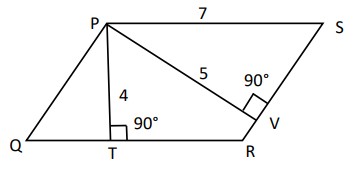
To solve this question, we need to determine the length of RS in the parallelogram PQRS. Given are PS = 7 cm, PT = 4 cm, and PV = 5 cm.
First, observe that the given figure contains right triangles \(PTQ\) and \(PVR\):
- \(\triangle PTQ\) has PT = 4 cm and this triangle is a right triangle.
- \(\triangle PVR\) also forms a right triangle with PV = 5 cm.
Since PQRS is a parallelogram, opposite sides are equal, hence PQ = RS.
Using the Pythagorean theorem in the right triangle \(\triangle PVR\), we have:
\(PV^2 + VR^2 = PR^2\)
We know: \(PV = 5\) cm.
To find VR, observe that VR = QT:
\(QT = \frac{PS \times PT}{PV} = \frac{7 \times 4}{5} = \frac{28}{5} \text{ cm}\)
Since opposite sides in a parallelogram are equal:
\(RS = QT = \frac{28}{5} \text{ cm}\)
Thus, the length of RS is \(\frac{28}{5} \text{ cm}\), which matches the correct option.
| Option | Length |
|---|---|
| \(\frac{20}{7}\) | Doesn't satisfy |
| \(\frac{28}{5}\) | Correct, as computed |
| \(\frac{9}{2}\) | Doesn't satisfy |
| \(\frac{35}{4}\) | Doesn't satisfy |
Therefore, the correct answer is \(\frac{28}{5}\).
Important Questions from Mensuration and Geometry
In the given figure, $P, Q$, and $R$ are three points on a circle of radius 10 cm with $O$ as its center, $\overline{PQ} = \overline{RQ}$, and $\angle PQR = 45^\circ$. The figure is representative.
The area of the shaded region $PQRO$ is ______________ cm$^2$.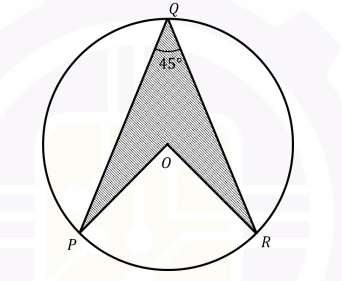
- A straight line $y = x - 1$ intersects a circle with center at $x = 1, y = 1$ and radius of magnitude 1 at two points. The length of the chord formed by this intersection is _______. (rounded off to three decimal places)
- The shell of a hollow spherical nanoparticle has a uniform thickness of 3 nanometers (nm). The outer radius of the nanoparticle is 5 nm. The ratio of the volume of the shell to the volume of the hollow core is ________
(Round off to one decimal place) - The volume of a sphere of diameter 1 unit is ______ than the volume of a cube of side 1 unit.
- A window is made up of a square portion and an equilateral triangle portion above it. The base of the triangular portion coincides with the upper side of the square. If the perimeter of the window is 6 m, the area of the window in $m^2$ is ______


