
In the given figure, AB is parallel to EF, ED is parallel to CB, and \(\angle BPD = 42^{\circ}\). What is the measure of \(\angle CQF\)?
\(138^{\circ}\)
Since AB is parallel to EF and CD is a transversal cutting both lines, \(\angle BPD\) and \(\angle CQF\) are formed on the same side of the transversal at the two parallel lines.
By the co-interior (same-side interior) angles property, angles on the same side of a transversal between two parallel lines are supplementary: \(\angle BPD + \angle CQF = 180^{\circ}\).
Substitute \(\angle BPD = 42^{\circ}\): \(42^{\circ} + \angle CQF = 180^{\circ}\).
Therefore \(\angle CQF = 180^{\circ} - 42^{\circ} = 138^{\circ}\).
Hence, the measure of \(\angle CQF\) is \(138^{\circ}\).
Similar Questions
Find the value of \(x\) if lines A and B are two parallel lines cut by a transversal t.
ABt65°xTwo parallel lines are cut by a transversal. If one of the interior angles measures \(70^\circ\), find the measure of the consecutive interior angle on the same side of the transversal.
Consider the following figure:
l₁l₂l₃l₄x°Y°Y°If \(l_1 \parallel l_2\) and \(l_3 \parallel l_4\), then which one of the following relations is correct?
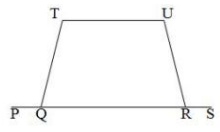
In the given figure, TU || PS and points Q and R lie on PS. Also, \(\angle PQT = x^\circ\), \(\angle RQT = (x - 50)^\circ\) and \(\angle TUR = (x + 25)^\circ\). What is the measure of \(\angle URS\)?
AA' and BB' are two parallel straight lines. CC' is a transversal that intersects AA' and BB' at points D and E respectively. If ∠B'EC' = 127° and ∠CDA' = (7x − 3)°, find the value of x.
Important Questions from Lines and Angles
There are three points P, Q and R on a straight line such that PQ : QR = 3 : 5. If n is the number of possible values of PQ : PR, then what is n equal to ?
Two cars start from a point at the same time and travel on two different roads at right angles to each other. Their speed is 18 km/h and 72 km/h respectively. What will be the distance between them after 6 seconds?
Express 65° in radian :
The measure of an angle for which the measure of the supplement is four times the measure of the complement is:
AB||CD and EF is the transversal meeting AB and CD at P and Q, respectively. If ∠APE = 6x and ∠PQD = 4x, then ∠APQ =______.



