
In the following reaction the major product [X] is
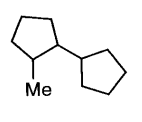
The given reaction involves an alkyl bromide with a double bond, undergoing a radical reaction with tributyltin hydride (Bu3SnH) in the presence of AIBN (Azobisisobutyronitrile) and heat. This is a classic example of a radical substitution reaction.
Here's the step-by-step mechanism:
- Initiation: AIBN decomposes to produce free radicals which initiate the radical reaction.
- Formation of Tin Radical: Bu3SnH reacts with the initiating radical to form Bu3Sn•, a tin radical.
- Radical Substitution: The tin radical abstracts the bromine atom from the alkyl bromide, generating an alkyl radical.
- Radical Rearrangement: The alkyl radical formed is a stable allylic radical due to the adjacent double bond. This stabilizes via resonance.
- Termination: The alkyl radical then reacts with another molecule of Bu3SnH to form the final alkene product, and regenerates the tin radical to propagate the chain reaction.
The major product is the most stable alkene formed through this allylic radical formation and subsequent hydrogen abstraction. This leads to the following product [X]:
Option 1 is the major product because the allylic radical is more stabilized, leading to the most substituted double bond.
Hence, the correct answer is the first option, which shows the alkene formation via the allylic radical mechanism.
Important Questions from Organic Transformations
The major product formed in the following reaction sequence is
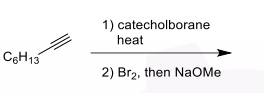
The major product formed in the following reaction sequence is
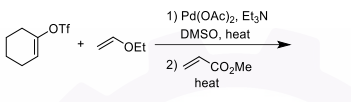
The major products X and Y in the following reaction sequence are
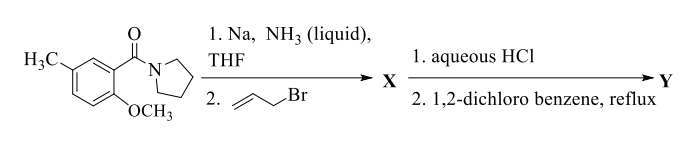
The following conversion is an example of
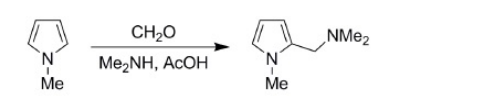
The major product formed in the reaction given below is



