
The major products X and Y in the following reaction sequence are 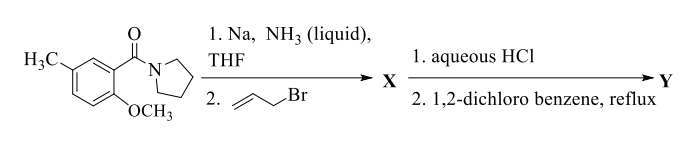
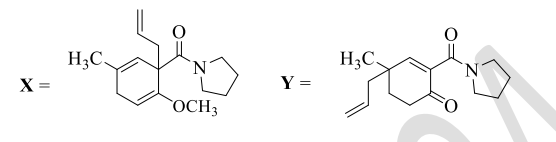
The given reaction sequence involves organic transformations that require understanding of reductions and nucleophilic substitutions. Let's break down the steps to identify the major products X and Y.
-
Reduction with Na/NH3 (liquid):
This is a Birch reduction reaction where an aromatic system is partially reduced. The presence of THF as a solvent suggests the reaction favors reduction of the aromatic ring. The result is the conversion of a cyclic ketone to an enolate that undergoes further reactions.
-
Nucleophilic Substitution:
This step involves the reaction with a bromoalkane, specifically CH_3CH_2CH_2Br. The enolate ion generated from the previous step acts as a nucleophile, attacking the alkyl halide and forming a new carbon-carbon bond, leading to compound X.
-
Acid Hydrolysis:
The reaction with aqueous HCl under acidic conditions leads to hydrolysis. If compound X includes any enol or derivative, it gets converted into its corresponding keto form.
-
Reflux with 1,2-dichlorobenzene:
This step involves heating, likely leading to a substitution or rearrangement process that finalizes the structure of compound Y. This heat-induced step facilitates cyclization or further substituent alterations.
Among the given options, is most consistent with the reaction mechanisms described above. The processes detailed lead logically to this structural result due to the presence of particular substituents and the configuration of rings.
In conclusion, understanding the sequence of reactions indicates that products X and Y correspond to the given correct option. Each step aligns with standard organic reaction pathways involving reductions, substitutions, and functional group transformations.
Important Questions from Organic Transformations
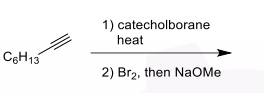
The major product formed in the following reaction sequence is
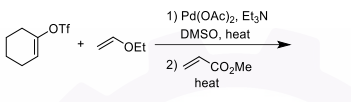
The major product formed in the following reaction sequence is
The following conversion is an example of
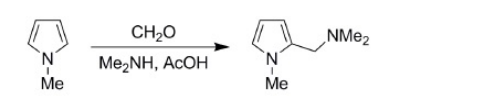
The major product formed in the reaction given below is

In the following reaction
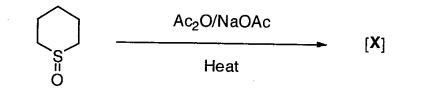
the major product [X] is


