
The major product formed in the following reaction sequence is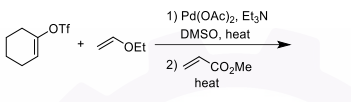
The given reaction sequence involves two main steps. Let's go through them one by one:
Heck Reaction: The first step involves the use of Pd(OAc)2 (Palladium acetate) and Et3N (Triethylamine) in DMSO with heat. This is indicative of a Heck reaction, which is a carbon-carbon bond-forming process between an aryl halide and an alkene. Here, the aryl triflate (OTf) serves as the substrate, reacting with the alkene [CH2=CHOC2H5]. This will result in the formation of a substituted alkene where the aryl group is attached to the terminal carbon of the alkene, replacing the triflate group.
Thermal Cycloaddition Reaction: In the second step, the newly formed product undergoes a cycloaddition with methyl acrylate [CH2=CHCO2Me] under heat. This step likely involves a [4+2] cycloaddition, commonly known as the Diels-Alder reaction, forming a cyclic compound.
To determine the major product, we must recognize that the initial Heck coupling will orient the structure for an optimal Diels-Alder reaction in the next step, resulting in a bicyclic product.
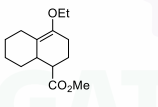
The correct structure resulting from these transformations is illustrated below:
Thus, the major product of this reaction sequence is the one formed by the Heck coupling followed by Diels-Alder cycloaddition, resulting in a bicyclic structure.
Important Questions from Organic Transformations
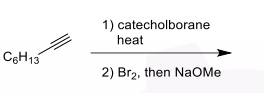
The major product formed in the following reaction sequence is
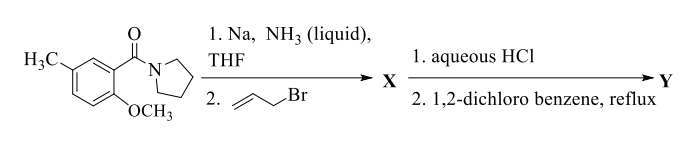
The major products X and Y in the following reaction sequence are
The following conversion is an example of
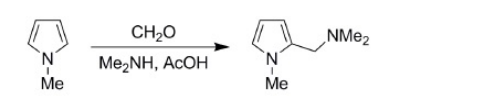
The major product formed in the reaction given below is

In the following reaction
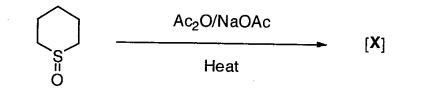
the major product [X] is


