In cyclic quadrilateral ABCD, if \(\angle A = 70^{\circ}\) and \(\angle B = 80^{\circ}\), find \(\angle D\).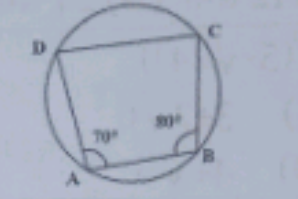
100°
In any cyclic quadrilateral, opposite angles are supplementary (they add up to \(180^{\circ}\)), because each pair of opposite angles subtends the full circle from opposite arcs.
In the given figure, vertices A and B are adjacent at the base, with C and D at the top, so the opposite pairs are (A, C) and (B, D).
Since \(\angle B\) and \(\angle D\) are opposite, \(\angle D = 180^{\circ} - \angle B = 180^{\circ} - 80^{\circ} = 100^{\circ}\).
Hence, \(\angle D = 100^{\circ}\).
Similar Questions
A survey team measures a rectangular plot of land. The length of the plot is 35 m and the diagonal connecting two opposite corners is 37 m. Find the width of the plot.
Important Questions from Quadrilaterals
What is the value of AC 2– BD 2
What is the point of intersection of the diagonals?
What is the area of the parallelogram?
ABCD is a cyclic quadrilateral. Diagonals BD and AC intersect each other at E. If ∠BEC = 138° and ∠ECD = 35°, then what is the measure of ∠BAC?
A circle is inscribed in a quadrilateral ABCD, touching sides AB, BC CD and DA at P, Q, R and S, respectively. If AS = 6 cm, BC = 12 cm, and CR = 5 cm, then the length of AB (in cm) is: