
ABCD is a cyclic quadrilateral. Diagonals BD and AC intersect each other at E. If ∠BEC = 138° and ∠ECD = 35°, then what is the measure of ∠BAC?
103°
Given:
BEC = 138° and ∠ECD = 35°
Concept Used:
In a cyclic quadrilateral, angles subtended by the same arc are always equal.
Calculation:
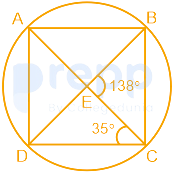
∠BEC and ∠CED lie on the same straight line.
∠BEC = 138°
∠CED = 180° – 138°
⇒ ∠CED = 42°
In ΔCDE, ∠CED = 42° and ∠DCE = 35°
∠CDE = 180° - (42° + 35°)
∠CDE = 103°
∠BAC and ∠BDC are subtended by the same arc BC.
We know that in a cyclic quadrilateral, angles subtended by the same arc are always equal.
∠BAC = 103°
∴ The measure of ∠BAC is 103°.
Important Questions from Quadrilaterals
What is the value of AC 2– BD 2
What is the area of the parallelogram?
A circle is inscribed in a quadrilateral ABCD, touching sides AB, BC CD and DA at P, Q, R and S, respectively. If AS = 6 cm, BC = 12 cm, and CR = 5 cm, then the length of AB (in cm) is:
Sides AB and DC of a cyclic quadrilateral ABCD are produced to meet at E and sides AD and BC are produced to meet at F. If ∠ADC = 78° and ∠BEC = 52°, then the measure of ∠AFB is:
ABCD is a cyclic quadrilateral. AB and DC meet at F, when produced. AD and BC meet at E, when produced. If ∠BAD = 68° and ∠AEB = 27°, then what is the measure of ∠BFC?


