
In an experiment, cows were allowed to graze in closed pastures either with wild deer or without wild deer. This experiment was done in the rainy and dry seasons. The results for weight gain in the cows (mean and $95\%$ confidence interval) are shown in the figure below. Based on these results which of the following statements is true?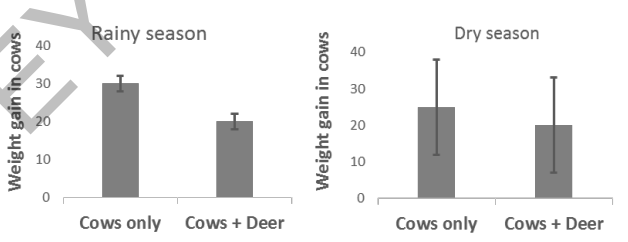
The given question asks us to determine the correct statement regarding the effect of wild deer on weight gain in cows during different seasons based on the provided experiment results shown in the figure.
- The figure illustrates cow weight gain during two seasons: the rainy season and the dry season. There are two conditions in each season:
- Cows grazing alone
- Cows grazing with wild deer
- In the rainy season:
- Cows grazing alone exhibit a higher mean weight gain compared to cows grazing with deer.
- The confidence intervals do not overlap significantly, suggesting a clear inhibitory effect of deer presence on weight gain during this season. Hence, it can be inferred that deer presence reduces weight gain in cows during the rainy season.
- In the dry season:
- The mean weight gain for cows grazing with deer is slightly lower than for those grazing alone, but the confidence intervals overlap considerably.
- This overlap indicates that the difference in weight gain between the two conditions is not statistically significant, suggesting no substantial inhibitory or enhancing effect of deer presence on weight gain.
- Conclusion: Based on the analysis, the effect of wild deer on weight gain in cows changes with the season:
- In the rainy season, the presence of deer negatively affects weight gain.
- In the dry season, there is no significant effect.
Important Questions from Competition
- Ecologists have studied the distributions of birds on archipelagos. Some studies found an interesting 'checkerboard' pattern within island groups. Sister species were never present on the same island, even when the islands were very close to each other. Which one of the following processes best explains this checkerboard pattern?
- Two bird species, A and B, are found on a single mountainside. A is a low-elevation species, found between 500 m and 1500 m Above Sea Level (ASL), while B is a high-elevation species, found between 1000 m and 2000 m ASL. At 1250 m ASL, species A and B have very different bill morphologies, but the bill morphology of species A at 500 m is very similar to the bill morphology of species B at 2000 m ASL. Which one or more of the following explain(s) the difference in bill morphology at 1250 m ASL?
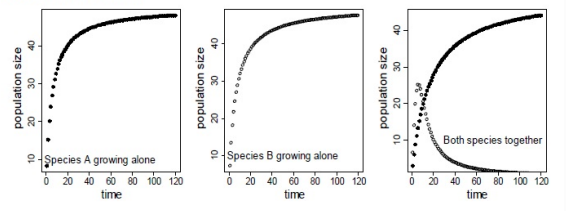
The figure panels below show population growth in two species (solid circles and open circles), when they are grown alone, and when they are grown together. The interaction between these species is an example of
- In an assemblage of coexisting wild cat species, the size of canine teeth was found to be strikingly different between these species. Which one or more of the following statements explain(s) this observation?
The barnacle species, Chthamalus stellatus (CS), is found only in the high intertidal zone whereas Balanus glandula (BG) is found only in the low intertidal zone. A researcher transplanted CS from the high to low (T-CS), and BG from the low to high (T-BG) intertidal zones. Additionally, they allowed the species to grow alone or in competition with each other, and quantified survival.
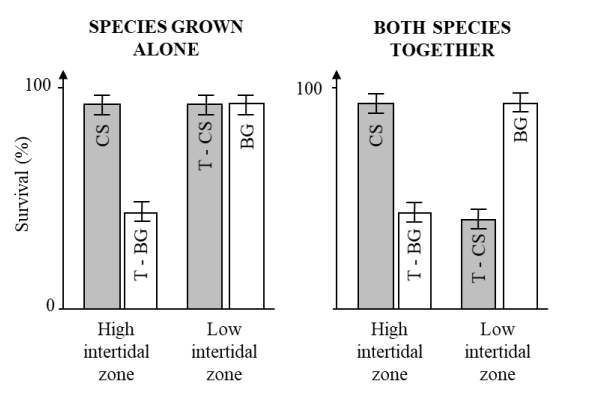
Which one or more of the following inferences is/are consistent with the experimental results shown below?


