
Saprolite Positioning in Weathering Profiles
A weathering profile describes the vertical layers formed by the breakdown of rock and soil formation. Saprolite is a specific layer within this profile.
Understanding Saprolite
Saprolite is defined as rock that has been chemically weathered to the extent that it loses its original strength but retains its original fabric (texture and structure). It represents a stage of intense weathering but is still essentially in situ (in its original place) rock.
Weathering Profile Layers
A typical weathering profile, from top to bottom, generally consists of:
- Surface litter/humus
- Soil horizons (topsoil, subsoil)
- Saprolite (highly weathered rock)
- Unweathered bedrock (parent rock)
Therefore, saprolite is found overlying the unweathered rock.
Analyzing the Options
Based on the typical structure of a weathering profile:
- Option 1 (below humus) is incorrect; saprolite is below humus but above bedrock.
- Option 2 (below soil) is correct in that it's below the soil layer, but option 4 is more specific about its lower boundary.
- Option 3 (above clay-rich horizon) is not always true; clay horizons can be within the soil or saprolite layer depending on the weathering process.
- Option 4 (above the unweathered rock) accurately describes the position of saprolite as the layer directly transitioning into the fresh bedrock.
The correct positioning of saprolite is immediately above the unweathered rock.
Important Questions from Weathering
- Bauxite formation is an example of metal enrichment by extreme
- Silcretes or silica-rich duricrusts generally form under
During normal weathering of a granite rock (A), clay minerals and then residue of gibbsite are formed. Which one is the correct weathering path for the rock in the given diagram ($\text{Al}_2\text{O}_3$, $\text{CaO}$, $\text{Na}_2\text{O}$ and $\text{K}_2\text{O}$ are in moles).
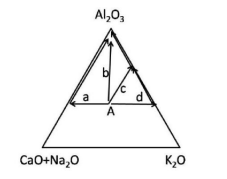
- During spheroidal weathering, a block of rock converts to a spheroid due to
- Which type(s) of chemical reactions occur(s) during the weathering of pyroxene?


