Bending Moment Discontinuity Causes
The bending moment diagram illustrates the internal bending moments acting along the length of a beam. A discontinuity, or a sudden jump, in this diagram signifies a specific type of load or support condition.
Let's analyze the effect of different scenarios on the bending moment diagram:
- Point of Application of a Couple: A couple is essentially a pure moment applied at a single point. When an external couple, denoted as $M_{ext}$, is applied to a beam, it directly adds or subtracts from the internal bending moment at that specific location. This results in an abrupt change or jump (discontinuity) in the bending moment diagram exactly at the point where the couple is applied. Mathematically, the moment immediately after the point ($M_{after}$) differs from the moment immediately before the point ($M_{before}$) by the magnitude of the applied couple: $M_{after} = M_{before} \pm M_{ext}$.
- Point of Application of a Concentrated Force: A concentrated force causes a discontinuity (a vertical jump) in the shear force diagram, not the bending moment diagram. The relationship between shear force ($V$) and bending moment ($M$) is given by $\frac{dM}{dx} = V$. A concentrated force changes the shear force abruptly, leading to a change in the slope of the bending moment diagram at that point, but the moment itself remains continuous.
- Point where Cross Section Changes Abruptly: An abrupt change in the beam's cross-section (and thus its moment of inertia, $I$) does not inherently cause a discontinuity in the bending moment diagram. While it affects stress and deflection calculations, the moment distribution itself is continuous unless accompanied by specific loads like couples or point loads at that section.
- Point where Shear Force is Zero: Points where the shear force is zero ($V=0$) typically correspond to locations of maximum or minimum bending moment. The bending moment diagram is continuous at these points; it reaches a peak or valley there, but it does not jump.
Based on this analysis, a discontinuity in the bending moment diagram specifically occurs at the point where a concentrated moment (a couple) is applied.
Correct Answer: The discontinuity in the bending moment diagram of a simply supported beam occurs at the point of application of a couple.
Important Questions from Analytical Aptitude
- The assumption that the probability of occurrence of a word in a string depends ONLY on the preceding word is called a ______ assumption.
- Which ONE of the following options represents the correct mapping of the phonetic features in Column X to their Sanskrit equivalents in Column Y?
Column X:
Phonetic featuresColumn Y:
Sanskrit termsP. voicing 1. prāṇa Q. retroflex 2. tālavya R. palatal 3. ghōṣa S. aspiration 4. mūrdhanya - Which ONE of the options represents the CORRECT mapping between the morphological concepts in Column X and the examples in Column Y?
Column X:
Morphological ConceptsColumn Y:
ExamplesP. Suppletion 1. bookmaker – bookie Q. Conversion 2. deer – deer R. Zero morpheme 3. bad – worst S. Hypocorism 4. arrive – arrival T. Derivation 5. (a) doctor – (to) doctor 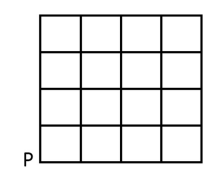
An ant is at the bottom-left corner of a grid (point P) as shown above. It aims to move to the top-right corner of the grid. The ant moves only along the lines marked in the grid such that the current distance to the top-right corner strictly decreases.
Which one of the following is a part of a possible trajectory of the ant during the movement?A building has several rooms and doors as shown in the top view of the building given below. The doors are closed initially.
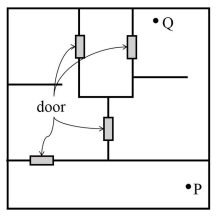
What is the minimum number of doors that need to be opened in order to go from the point P to the point Q?