
Volume Calculation for a Right Circular Cone
The volume ($V$) of a right circular cone is given by the formula:
$ V = \frac{1}{3} \pi r^2 h $
where $r$ is the radius of the base and $h$ is the height of the cone.
Calculating Initial Volume
Let the initial radius be $r$ and the initial height be $h$. The initial volume ($V_1$) is:
$ V_1 = \frac{1}{3} \pi r^2 h $
Calculating New Volume After Radius Increase
The radius is increased by 50%. The new radius ($r'$) is:
- Increase in radius = $50\%$ of $r = 0.50r$.
- New radius, $r' = r + 0.50r = 1.5r$.
The height ($h$) remains unchanged. The new volume ($V_2$) is:
$ V_2 = \frac{1}{3} \pi (r')^2 h $
Substitute $r' = 1.5r$:
$ V_2 = \frac{1}{3} \pi (1.5r)^2 h $
$ V_2 = \frac{1}{3} \pi (2.25 r^2) h $
$ V_2 = 2.25 \times \left( \frac{1}{3} \pi r^2 h \right) $
Since $V_1 = \frac{1}{3} \pi r^2 h$, we have:
$ V_2 = 2.25 V_1 $
Determining Percentage Volume Increase
The increase in volume is:
$ \Delta V = V_2 - V_1 = 2.25 V_1 - V_1 = 1.25 V_1 $
The percentage increase in volume is calculated as:
$ \text{Percentage Increase} = \frac{\Delta V}{V_1} \times 100\% $
$ \text{Percentage Increase} = \frac{1.25 V_1}{V_1} \times 100\% $
$ \text{Percentage Increase} = 1.25 \times 100\% = 125\% $
Therefore, if the radius of a right circular cone is increased by 50%, its volume increases by 125%.
Important Questions from Mensuration and Geometry
In the given figure, $P, Q$, and $R$ are three points on a circle of radius 10 cm with $O$ as its center, $\overline{PQ} = \overline{RQ}$, and $\angle PQR = 45^\circ$. The figure is representative.
The area of the shaded region $PQRO$ is ______________ cm$^2$.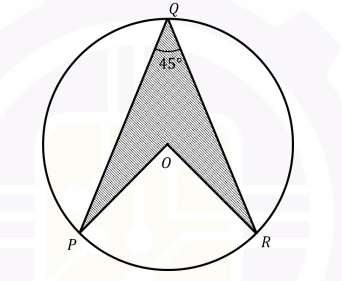
- A straight line $y = x - 1$ intersects a circle with center at $x = 1, y = 1$ and radius of magnitude 1 at two points. The length of the chord formed by this intersection is _______. (rounded off to three decimal places)
- The shell of a hollow spherical nanoparticle has a uniform thickness of 3 nanometers (nm). The outer radius of the nanoparticle is 5 nm. The ratio of the volume of the shell to the volume of the hollow core is ________
(Round off to one decimal place) - The volume of a sphere of diameter 1 unit is ______ than the volume of a cube of side 1 unit.
- A window is made up of a square portion and an equilateral triangle portion above it. The base of the triangular portion coincides with the upper side of the square. If the perimeter of the window is 6 m, the area of the window in $m^2$ is ______


