
If radiant energy EB emitted by the black surface strikes the non-black surface and if the non-black surface has absorptivity α, then it will absorb how much radiation?
This question relates to the fundamental concepts of thermal radiation and how surfaces interact with incoming energy. Specifically, it deals with the property of absorptivity.
Understanding Radiant Energy Absorption
When radiant energy strikes a surface, a portion of that energy can be absorbed, reflected, or transmitted. The question specifies that radiant energy, denoted as $E_B$, originating from a black surface, is incident upon a non-black surface.
A key property governing how much radiation a surface absorbs is its absorptivity, represented by the Greek letter $\alpha$ (alpha).
By definition, absorptivity ($\alpha$) is the ratio of the absorbed radiation to the incident radiation. Mathematically, this can be expressed as:
$$ \alpha = \frac{\text{Absorbed Radiation}}{\text{Incident Radiation}} $$
Calculating Absorbed Radiation
The question provides the following information:
- Incident radiant energy = $E_B$
- Absorptivity of the non-black surface = $\alpha$
To find out how much radiation the non-black surface will absorb, we can rearrange the definition of absorptivity:
$$ \text{Absorbed Radiation} = \alpha \times \text{Incident Radiation} $$
Substituting the given values into this formula:
$$ \text{Absorbed Radiation} = \alpha \times E_B $$
Therefore, the amount of radiation absorbed by the non-black surface is $\alpha E_B$.
Analyzing the Options
Based on the calculation, the absorbed radiation is represented by the term $\alpha E_B$. Comparing this with the given options:
- Option 1: $\alpha E_B$
- Option 2: $2 \alpha E_B$
- Option 3: $3 \alpha E_B$
- Option 4: $4 \alpha E_B$
The calculated absorbed radiation directly matches the first option.
Important Questions from Radiation
- A body is placed inside a perfectly black enclosure and is allowed to reach thermal equilibrium. According to the Kirchhoff’s identity, which one of the following is equal to the emissivity of the body at a given wavelength?
Thermal radiation takes place at a surface which has reflectivity of 0.55 and a transmissivity of 0.032. What is the value of absorptivity?
Two infinitely large parallel plates (I and II) are held at temperatures $T_I$ and $T_{II}$ ($T_I > T_{II}$) respectively, and placed at a distance $2d$ apart in vacuum. An infinitely large flat radiation shield (III) is placed in parallel in between I and II. The emissivities of all the plates are equal. The ratio of the steady state radiative heat fluxes with and without the shield is:
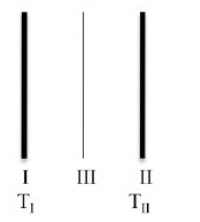
- Two very large parallel walls (gray bodies) facing each other have emissivities of 0.5 and 0.7. The view factor between these two walls is ________.
- The space between two hollow concentric spheres of radii 0.1 m and 0.2 m is under vacuum.
Exchange of radiation (uniform in all directions) occurs only between the outer surface ($S_1$) of the smaller sphere and the inner surface ($S_2$) of the larger sphere. The fraction (rounded off to the second decimal place) of the radiation energy leaving $S_2$, which reaches $S_1$ is


