
Question
If fayalite mineral in a bedrock has weathered to goethite, what would have been the sequence of weathering reactions?
The correct answer is
carbonation, hydrolysis, oxidation
Fayalite Weathering Sequence Explained
The transformation of fayalite (an iron silicate mineral, Fe$_2$SiO$_4$) into goethite (an iron oxyhydroxide, FeO(OH)) involves a specific sequence of chemical weathering reactions.
Reaction Steps
- Carbonation: Weathering often begins with carbonation. Carbon dioxide (CO$_2$) from the atmosphere dissolves in water to form carbonic acid (H$_2$CO$_3$). This weak acid attacks the mineral surface, initiating the breakdown process.
- Hydrolysis: Following carbonation, hydrolysis occurs. Water molecules, often aided by the carbonic acid, react with the mineral's structure. This breaks the chemical bonds holding the fayalite structure together, releasing ions like ferrous iron (Fe$^{2+}$) and silicate components (e.g., silicic acid, H$_4$SiO$_4$). The general reaction involves breaking silicate and metal-oxygen bonds.
- Oxidation: The released ferrous iron (Fe$^{2+}$), which is soluble, is readily oxidized to ferric iron (Fe$^{3+}$) in the presence of oxygen, a common condition in near-surface environments. This changes the iron's oxidation state.
- Precipitation: The oxidized ferric iron (Fe$^{3+}$) then reacts with water and hydroxide ions to form stable iron oxyhydroxides, such as goethite (FeO(OH)).
Conclusion
Therefore, the logical sequence for the weathering of fayalite to goethite is:
- Carbonation
- Hydrolysis
- Oxidation
This corresponds to Option C.
Was this answer helpful?
Important Questions from Weathering
- Bauxite formation is an example of metal enrichment by extreme
- Silcretes or silica-rich duricrusts generally form under
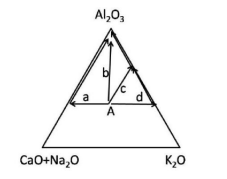
During normal weathering of a granite rock (A), clay minerals and then residue of gibbsite are formed. Which one is the correct weathering path for the rock in the given diagram ($\text{Al}_2\text{O}_3$, $\text{CaO}$, $\text{Na}_2\text{O}$ and $\text{K}_2\text{O}$ are in moles).
- During spheroidal weathering, a block of rock converts to a spheroid due to
- Which type(s) of chemical reactions occur(s) during the weathering of pyroxene?
Need Expert Advice?


