Solving Cubic Equation Roots for Value of p
This solution explains how to find the value of 'p' in the cubic equation $2x^3 – 3x^2 + px – 1 = 0$, given that 'a', 'b', and 'c' are its roots and the sum of two of the roots is 1.
Understanding the Cubic Equation and Vieta's Formulas
We are given a cubic equation: $2x^3 – 3x^2 + px – 1 = 0$ Let the roots of this equation be a, b, and c. According to Vieta's formulas, for a general cubic equation $Ax^3 + Bx^2 + Cx + D = 0$, the relationships between the coefficients and the roots are:
- Sum of roots: $a + b + c = -B/A$
- Sum of the products of roots taken two at a time: $ab + ac + bc = C/A$
- Product of roots: $abc = -D/A$
Applying Vieta's Formulas to the Specific Equation
For our equation, $2x^3 – 3x^2 + px – 1 = 0$, we identify the coefficients:
- $A = 2$
- $B = -3$
- $C = p$
- $D = -1$
Using Vieta's formulas, we can establish the following relations:
- Sum of roots: $a + b + c = -(-3)/2 = 3/2$
- Sum of pairwise products: $ab + ac + bc = p/2$
- Product of roots: $abc = -(-1)/2 = 1/2$
Using the Given Condition on Roots
The problem states that the sum of two of the roots is 1. Let's assume $a + b = 1$.
We can use the sum of the roots formula ($a + b + c = 3/2$) to find the value of the third root, 'c'.
Substitute the known value of $a + b$ into the sum of roots equation:
$ (a + b) + c = 3/2 $ $ 1 + c = 3/2 $Now, we solve for 'c':
$ c = 3/2 - 1 $ $ c = 3/2 - 2/2 $ $ c = 1/2 $Therefore, the third root of the cubic equation is $1/2$.
Calculating the Value of p
Since $c = 1/2$ is a root of the equation $2x^3 – 3x^2 + px – 1 = 0$, it must satisfy the equation. We can substitute $x = 1/2$ into the equation to find the value of 'p'.
Substituting $x = 1/2$ into the cubic equation:
$ 2(1/2)^3 – 3(1/2)^2 + p(1/2) – 1 = 0 $Now, let's simplify the powers and products:
- $2 \times (1/8) = 1/4$
- $3 \times (1/4) = 3/4$
- $p \times (1/2) = p/2$
Substitute these simplified terms back into the equation:
$ 1/4 – 3/4 + p/2 – 1 = 0 $Combine the constant terms:
$ (1/4 - 3/4) - 1 + p/2 = 0 $ $ -2/4 - 1 + p/2 = 0 $ $ -1/2 - 1 + p/2 = 0 $ $ -3/2 + p/2 = 0 $Now, isolate the term containing 'p' and solve for 'p':
$ p/2 = 3/2 $Multiply both sides by 2:
$ p = (3/2) \times 2 $ $ p = 3 $Alternative Method using Pairwise Products:
We can also use the formula $ab + ac + bc = p/2$.
Factor out 'c' from the terms involving it: $ab + c(a + b) = p/2$.
From our previous steps, we know:
- $a + b = 1$
- $c = 1/2$
We also know the product of roots $abc = 1/2$. Substituting $c = 1/2$, we get $ab(1/2) = 1/2$, which implies $ab = 1$.
Now substitute the values of $ab$, $c$, and $a+b$ into the pairwise product equation:
$ 1 + (1/2)(1) = p/2 $ $ 1 + 1/2 = p/2 $ $ 3/2 = p/2 $Solving for 'p', we multiply both sides by 2:
$ p = 3 $Both methods confirm that the value of p is 3.
Important Questions from Polynomial Roots
- Solution of $f(x) = x^4 + 2x^3 - 4x^2 + 3x - 1 = 0$ is
- Let $r$ be a root of the equation $x^2 + 2x + 6 = 0$.
Then the value of the expression $(r + 2)(r + 3)(r + 4)(r + 5)$ is The smallest positive root of the equation
$x^5 - 5x^4 - 10 x^3 + 50 x^2 + 9 x - 45 = 0$
lies in the range
- Consider the following equation:
$x^3 - 10x^2 + 31x - 30 = 0$
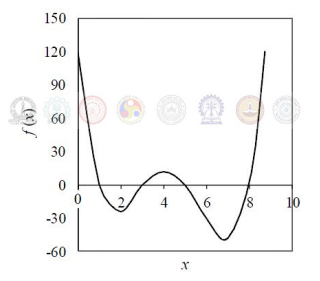
Which of the following is/are the root(s) of the above equation? The number of positive roots of the function $f(x)$ shown below in the range $0 < x < 6$ is ____.