
Polynomial Equation Solution
We need to find a root for the polynomial equation:
$f(x) = x^4 + 2x^3 - 4x^2 + 3x - 1 = 0$
The options provided are numerical values. We can find the approximate solution by substituting each option into the function $f(x)$ and identifying which value makes $f(x)$ closest to zero.
Function Evaluation for Options
Let's evaluate the polynomial $f(x)$ for each given option:
- Option 1: $x \approx 0.333$ $f(0.333) \approx (0.333)^4 + 2(0.333)^3 - 4(0.333)^2 + 3(0.333) - 1 \approx -0.3585$
- Option 2: $x \approx 0.646$ $f(0.646) \approx (0.646)^4 + 2(0.646)^3 - 4(0.646)^2 + 3(0.646) - 1 \approx -0.0171$
- Option 3: $x \approx 0.658$ $f(0.658) \approx (0.658)^4 + 2(0.658)^3 - 4(0.658)^2 + 3(0.658) - 1 \approx -0.0013$
- Option 4: $x = 1$ $f(1) = 1^4 + 2(1)^3 - 4(1)^2 + 3(1) - 1 = 1 + 2 - 4 + 3 - 1 = 1$
Solution Comparison
Comparing the absolute values of $f(x)$ for each option helps determine which is closest to a root (where $f(x)=0$):
| Option ($x$) | $f(x)$ | $|f(x)|$ |
|---|---|---|
| 0.333 | $\approx -0.3585$ | $\approx 0.3585$ |
| 0.646 | $\approx -0.0171$ | $\approx 0.0171$ |
| 0.658 | $\approx -0.0013$ | $\approx 0.0013$ |
| 1 | $1$ | $1$ |
The absolute value $|f(x)| \approx 0.0013$ is the smallest among the options, corresponding to $x \approx 0.658$. Thus, $0.658$ is the best approximation of the solution to the equation $f(x) = 0$ among the choices provided.
Important Questions from Polynomial Roots
- Let $r$ be a root of the equation $x^2 + 2x + 6 = 0$.
Then the value of the expression $(r + 2)(r + 3)(r + 4)(r + 5)$ is The smallest positive root of the equation
$x^5 - 5x^4 - 10 x^3 + 50 x^2 + 9 x - 45 = 0$
lies in the range
- Consider the following equation:
$x^3 - 10x^2 + 31x - 30 = 0$
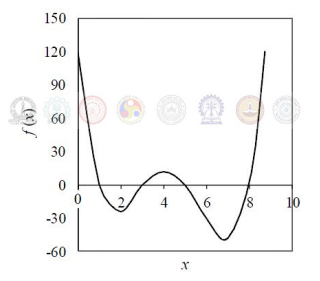
Which of the following is/are the root(s) of the above equation? The number of positive roots of the function $f(x)$ shown below in the range $0 < x < 6$ is ____.
The product of the roots of the equation $x^4 + 1 = 0$ is _________ (answer in integer).


