
The smallest positive root of the equation $x^5 - 5x^4 - 10 x^3 + 50 x^2 + 9 x - 45 = 0$ lies in the range
Finding the Smallest Positive Root of the Polynomial
We are asked to find the smallest positive root of the equation:
$x^5 - 5x^4 - 10 x^3 + 50 x^2 + 9 x - 45 = 0$
Let the polynomial be $P(x) = x^5 - 5x^4 - 10 x^3 + 50 x^2 + 9 x - 45$. We can try to factor this polynomial by grouping terms.
Polynomial Factorization
Group the terms as follows:
$ (x^5 - 5x^4) + (-10 x^3 + 50 x^2) + (9 x - 45) = 0 $
Factor out common terms from each group:
$ x^4(x - 5) - 10x^2(x - 5) + 9(x - 5) = 0 $
Notice that $(x - 5)$ is a common factor:
$ (x - 5)(x^4 - 10x^2 + 9) = 0 $
Solving the Factors
This equation holds if either factor is zero:
- $x - 5 = 0 \implies x = 5$
- $x^4 - 10x^2 + 9 = 0$
For the second factor, let $y = x^2$. The equation becomes a quadratic in $y$:
$ y^2 - 10y + 9 = 0 $
Factor the quadratic equation:
$ (y - 1)(y - 9) = 0 $
This gives $y = 1$ or $y = 9$. Substitute back $x^2 = y$:
- If $y = 1$, then $x^2 = 1 \implies x = \pm 1$.
- If $y = 9$, then $x^2 = 9 \implies x = \pm 3$.
Identifying Roots and the Smallest Positive Root
The roots of the original equation are $5, 1, -1, 3, -3$.
The positive roots are $1, 3, 5$.
The smallest positive root is $x=1$.
Determining the Correct Interval
We need to find the interval that contains the smallest positive root, $x=1$. Let's check the given options:
- Option 1: $0 < x \le 2$. Since $0 < 1 \le 2$, this interval contains the root $x=1$.
- Option 2: $2 < x \le 4$. $x=1$ is not in this interval.
- Option 3: $6 \le x \le 8$. $x=1$ is not in this interval.
- Option 4: $10 \le x \le 100$. $x=1$ is not in this interval.
Therefore, the smallest positive root lies in the interval $0 < x \le 2$.
Important Questions from Polynomial Roots
- Solution of $f(x) = x^4 + 2x^3 - 4x^2 + 3x - 1 = 0$ is
- Let $r$ be a root of the equation $x^2 + 2x + 6 = 0$.
Then the value of the expression $(r + 2)(r + 3)(r + 4)(r + 5)$ is - Consider the following equation:
$x^3 - 10x^2 + 31x - 30 = 0$
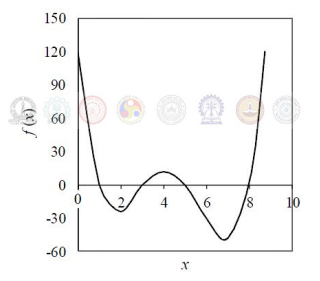
Which of the following is/are the root(s) of the above equation? The number of positive roots of the function $f(x)$ shown below in the range $0 < x < 6$ is ____.
The product of the roots of the equation $x^4 + 1 = 0$ is _________ (answer in integer).


