
Silicate Weathering Lowers Atmospheric $\text{CO}_2$
Silicate weathering is a natural geological process where silicate rocks react with rainwater containing dissolved carbon dioxide ($\text{CO}_2$). This process consumes atmospheric $\text{CO}_2$.
The basic chemical reaction involves carbonic acid (formed from water and $\text{CO}_2$) breaking down silicate minerals. This reaction effectively removes $\text{CO}_2$ from the atmosphere and stores it in soluble forms (like bicarbonate ions) in water bodies, eventually leading to mineral formation on the ocean floor.
A higher rate of silicate weathering means this $\text{CO}_2$ consumption process accelerates. Therefore, increased weathering activity leads to a net removal of $\text{CO}_2$ from the atmosphere.
- Process: Silicate rocks + $\text{H}_2\text{O}$ + $\text{CO}_2$ $\rightarrow$ Dissolved ions (e.g., $\text{HCO}_3^-$) + Clay minerals
- Impact: Increased weathering rate $\rightarrow$ Faster $\text{CO}_2$ consumption
- Result: Decrease in atmospheric $\text{CO}_2$ levels.
This mechanism acts as a long-term regulator of Earth's climate by influencing the concentration of the greenhouse gas $\text{CO}_2$. A higher weathering rate cools the planet, while a lower rate can lead to warming.
Important Questions from Weathering
- Bauxite formation is an example of metal enrichment by extreme
- Silcretes or silica-rich duricrusts generally form under
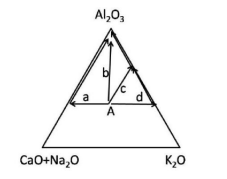
During normal weathering of a granite rock (A), clay minerals and then residue of gibbsite are formed. Which one is the correct weathering path for the rock in the given diagram ($\text{Al}_2\text{O}_3$, $\text{CaO}$, $\text{Na}_2\text{O}$ and $\text{K}_2\text{O}$ are in moles).
- During spheroidal weathering, a block of rock converts to a spheroid due to
- Which type(s) of chemical reactions occur(s) during the weathering of pyroxene?


